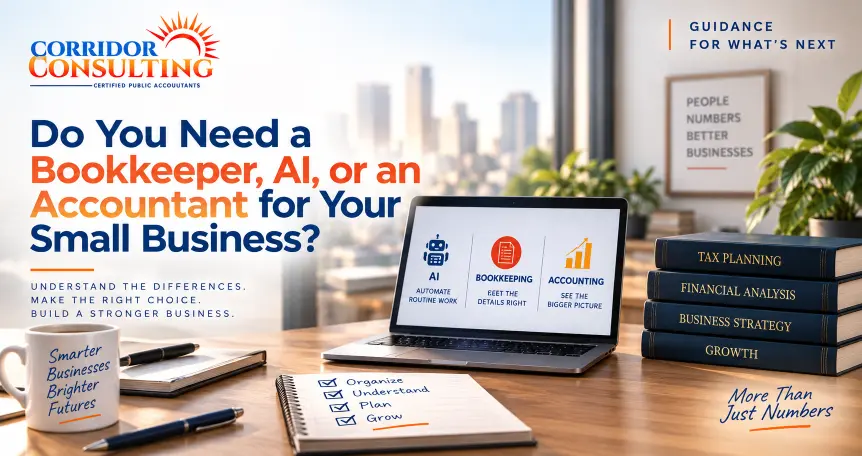
Do You Need a Bookkeeper, AI, or an Accountant for Your Small Business?
If you’re comparing a bookkeeper vs. accountant for your small business, there’s now a third option to consider: AI.
Do you actually need a bookkeeper or accountant anymore?
For some business owners, the answer may be no.
AI and modern accounting software are getting very good at answering a basic question:
How do I record this transaction?
If you are a solo operator with simple revenue, a business checking account, a credit card, and relatively straightforward expenses, that may be most of what you need.
And that’s okay.
You shouldn’t pay professional accounting fees to have someone manually classify your Home Depot transactions if software can reliably do it for you.
But as your business grows, the question changes.
It becomes less about how to record a transaction and more about what the financial information is telling you about your business.
That’s the difference between bookkeeping and accounting.
And understanding that difference can help you decide whether your business needs AI, a bookkeeper, an accountant, or a combination of all three.
Bookkeeper vs. Accountant: What’s the Difference?
One of my Intermediate Accounting professors told us while we were pursuing our accounting degrees that we should always correct anyone who referred to us as bookkeepers.
The distinction he instilled in us has stuck with me throughout my career.
A bookkeeper is primarily trying to answer:
How do I record this?
An accountant should be asking:
What actually happened economically?
How should it be represented?
What does it mean?
And what should we do with that information?
That distinction matters even more today because AI is becoming increasingly capable of answering the first question.
I welcome that.
There isn’t much value for an accountant to deliver to a business owner when the owner already knows how to record the transaction, or software can reliably do it for them.
The opportunity is to spend more time answering the other questions.
When AI Bookkeeping May Be All Your Business Needs
Let’s start with something accounting firms probably don’t say often enough:
Not every small business needs sophisticated accounting.
Imagine you’re a solo consultant.
You have one business checking account and one credit card. Customers pay you for your services. You don’t carry inventory. You don’t have employees. You don’t have complicated contracts. Your expenses consist primarily of software subscriptions, insurance, professional fees, travel and ordinary operating costs.
There may simply not be that much accounting complexity.
Whether a $75 software charge lands in “Software” or “Office Expense” may make virtually no difference to your ability to operate the business.
There may also be relatively few differences between how your business recognizes revenue and expenses in its books and how those items are ultimately treated for income-tax purposes.
In that situation, AI-enabled accounting software may handle a substantial portion of the transaction-classification work.
Great.
Business should be this easy.
You shouldn’t create complexity simply to justify hiring an accountant.
You still need adequate records. The IRS says businesses need records that clearly show income and expenses, support the preparation of financial statements and tax returns, and substantiate amounts reported on those returns. Electronic accounting systems are perfectly acceptable, but the records still need to be complete and accurate.
The tool has changed. The responsibility for maintaining adequate records hasn’t.
When a Bookkeeper Makes Sense
There is still an important role for bookkeeping. When comparing a bookkeeper vs. accountant, transaction volume is one of the first things to consider.
Your business may have straightforward accounting but enough transaction volume that you shouldn’t be spending your own time maintaining the records.
Maybe you have:
- Hundreds of transactions each month
- Multiple bank and credit card accounts
- Customer invoices and accounts receivable
- Vendor bills and accounts payable
- Payroll transactions
- Regular reconciliations
- Receipt and document management
You may understand perfectly well what these transactions are.
You just shouldn’t be spending five hours every week recording them.
That’s an operational problem.
A good bookkeeper, increasingly assisted by AI and automation, can maintain those records while you spend your time running the business.
But transaction volume isn’t the same thing as accounting complexity.
A company can have thousands of very simple transactions.
Another company can have relatively few transactions where the accounting treatment of each one matters considerably.
That’s where the distinction becomes important.
When Your Business Needs an Accountant
Eventually, many growing businesses reach a point where simply knowing that they made money isn’t enough. The bookkeeper vs. accountant decision starts to change when simply knowing that your business made money isn’t enough.
Suppose your income statement says:
Revenue: $2,000,000
Net Income: $200,000
That’s useful.
But now you have questions.
Which customers generated the profit?
Which contracts met the margin you bid?
Are certain services subsidizing others?
Are labor costs being assigned correctly?
Should some costs be included in cost of goods sold rather than operating expenses?
Why is cash declining while the income statement shows a profit?
Are customer deposits actually revenue yet?
Should an expenditure be expensed, capitalized or depreciated?
What happens to taxes if you hire another employee?
Should you consider an S corporation election?
How should owner compensation be structured?
Can the business reimburse employees or owners for certain expenses?
Can you afford to delegate work currently performed by the owner?
What happens to profitability if you change a contract term?
Now we’re doing accounting.
The question is no longer simply:
How do I record this?
The question is:
What happened, why did it happen, and what should we do about it?
When It’s No Longer Just Your Money
The bookkeeper vs. accountant question also becomes more consequential when you’re no longer the only person with money at risk.
If you take on partners, shareholders or outside investors, you’re no longer simply deciding how much financial information you personally need to run your business.
You may now have legal and contractual duties to other people.
That doesn’t automatically mean every business with multiple owners is legally required to hire a CPA.
But it does mean the question changes.
The question is no longer simply:
“Can AI categorize these transactions?”
It becomes:
“Have we established a financial process appropriate for a business where we’re responsible for other people’s money?”
Who is reviewing the financial statements?
Who understands whether the accounting actually represents what happened economically?
Who is making sure the books can support the tax returns?
Who is identifying unusual transactions or accounting problems?
Who is coordinating with payroll providers, bookkeepers, attorneys and other professionals?
Who is responsible for making sure those parties are providing the information the business needs?
And when management relies on someone for accounting, tax or financial expertise, is that person actually qualified to provide the expertise management is relying upon?
Those questions become much more important as ownership, capital and complexity increase.
For example, Iowa corporate law expressly recognizes that directors may rely on financial statements and other financial information prepared by people they reasonably believe are competent, including public accountants and other professionals with appropriate expertise. Iowa LLC law similarly recognizes good-faith reliance on information from someone reasonably believed to be a competent and reliable source.
That doesn’t mean the law requires you to hire a CPA every time you take on a partner.
It does illustrate something important:
Delegating the work doesn’t necessarily eliminate your responsibility for exercising appropriate oversight over the financial side of the business.
AI can be part of that system. A bookkeeper can be part of that system. Your payroll company can be part of that system.
But as the amount of other people’s money you’re responsible for increases, having a qualified professional overseeing how those pieces fit together can become considerably more important.
At that point, professional accounting isn’t merely about categorizing transactions. It can become part of the financial governance of the business.
Accurate Accounting Becomes the Foundation for Better Decisions
This is where I think many conversations about AI bookkeeping miss the bigger picture.
The books aren’t merely something you clean up once a year so your CPA can prepare a tax return. The IRS itself identifies monitoring the progress of the business as one of the reasons businesses should maintain good records.
For a growing business, the accounting records become the financial infrastructure supporting decisions throughout the year.
Consider a recent strategy meeting we had with one of our Business Solutions clients.
We discussed organized financial statements, a potential future S corporation election, accountable plans, per diem, compensation, future cost accounting, contracts, bidding, margins, internal controls, expansion and delegating work off the owner’s plate.
We’ll also use those same records for tax planning.
Future cost accounting work will influence how the business evaluates contracts and bids future work.
Compensation decisions affect both operations and taxes.
Expansion decisions affect cash flow, staffing and profitability.
Eventually, those accounting records become the starting point for preparing the business tax return.
And the information generated from the business will also influence the owner’s personal tax and legacy planning.
It’s all connected.
If the underlying accounting isn’t accurate, everything you’re building on top of it becomes less reliable.
Your Books and Your Tax Return Aren’t Separate Worlds
This is another area business owners frequently don’t see.
Your accountant doesn’t simply throw away your books at year-end and create an unrelated set of numbers for the IRS.
Your accounting records are generally foundational to preparing the tax return.
The IRS itself says that good business records help prepare financial statements and tax returns, identify sources of income, track deductible expenses and support the amounts reported on a tax return.
The IRS also requires businesses to use an accounting method that clearly reflects income. Depending on the business and applicable rules, that might involve the cash method, accrual method or specific accounting treatment for particular items.
That becomes increasingly important as the business becomes more complicated.
A growing business might encounter questions involving depreciation, inventory, capitalization, prepaid expenses, accrued expenses, owner compensation, shareholder transactions, employee reimbursements, loans, distributions and other book-to-tax differences.
The accounting needs to provide enough information for someone to identify and properly handle those issues.
AI categorizing the transaction is useful.
But categorization isn’t necessarily the end of the accounting question.
The Same Transaction Can Tell You Much More Than Its Expense Category
Suppose your construction business spends $20,000 on labor.
An automated system might correctly determine:
Labor Expense: $20,000
Great.
But an accountant may want to know considerably more.
Which project did that labor relate to?
Was it included in the original estimate?
What labor margin was assumed when the contract was priced?
Did the project exceed its estimated hours?
Is this happening across multiple contracts?
Should future bids be adjusted?
Is the company measuring its actual gross margin correctly?
Could a change in contract terms reduce the company’s risk?
Suddenly, the important question isn’t whether AI correctly categorized the $20,000.
The important question is whether the accounting system captured the information management needs to make the next decision.
That’s a very different problem.
AI Should Make Accounting Firms Better
AI is also changing the traditional bookkeeper vs. accountant relationship by automating more of the transaction-level work.
We should welcome it.
If AI can accurately classify routine transactions, extract information from documents, suggest entries, automate reconciliations and identify anomalies, accountants should use those capabilities.
Business owners shouldn’t pay professional accounting rates for work that software can perform reliably.
But eliminating manual transaction entry doesn’t eliminate the need for accounting judgment.
It should give accountants more time to provide it.
The accountant of the future shouldn’t spend most of the relationship asking:
Where should I categorize this receipt?
They should have more time to ask:
Why did your margin fall three points?
Why isn’t this contract performing like you expected?
What happens if you hire another employee?
Can your pricing support the expansion you’re considering?
How does this decision affect your taxes?
How does the business decision affect your personal financial plan?
Those are considerably more valuable conversations.
Bookkeeper vs. Accountant vs. AI: Which Do You Need?
A simple way to think about it is this.
Use AI and accounting software when:
Your business is simple, transaction volume is manageable, revenue and expenses are straightforward, and you primarily need help recording and categorizing transactions.
There is nothing wrong with this.
Keep your business simple for as long as you can.
Consider a bookkeeper when:
Your accounting is still relatively straightforward, but maintaining the records is consuming time that would be better spent operating your business.
You’re primarily solving a capacity problem.
Consider an accountant when:
The financial information itself has become important to your decisions.
You need to understand profitability by customer, contract, project, location or service.
You’re hiring employees, changing compensation, adding owners, acquiring significant assets, considering entity or tax elections, expanding operations, developing cost accounting, changing pricing or bidding significant contracts.
You’re no longer simply asking someone to maintain your records.
You’re asking someone to help you understand and use them.
You may need all three.
For many growing businesses, this isn’t actually an either/or decision.
AI handles automation.
Bookkeeping processes maintain the transaction-level records.
Accounting turns those records into useful financial information.
Professional judgment connects that information to tax, operations, compensation, pricing, growth and eventually the owner’s personal financial decisions.
That’s where we believe the profession is heading.
Don’t Pay for Complexity You Don’t Need
If you’re a solo operator with simple revenue and expenses, you may not need us.
Seriously.
Use good software. Use AI where it works. Maintain your supporting documentation. Reconcile your accounts. Keep accurate records. Make sure your tax filings are correct.
Business should be this easy.
But if you’re trying to build something larger, the accounting system you’re building today can become the foundation for the decisions you’ll need to make tomorrow.
That’s when the conversation changes.
The question stops being:
Who can categorize my transactions?
And becomes:
Who understands what these numbers mean and can help me use them to build a better business?
That’s accounting.
Building a Business? Build the Accounting Foundation With It.
At Corridor Consulting LLC, our Business Solutions work is designed for business owners who need more than transaction classification.
We help owners connect their accounting, tax planning and business decisions so their financial information can actually be used to operate and grow the business.
That can include financial reporting, tax planning, entity and compensation planning, cost accounting, profitability analysis, operational controls, pricing and contract considerations, and planning around growth and delegation.
If your business is simple and AI can handle most of your bookkeeping and accounting needs, that’s a good thing.
If you’ve reached the point where the numbers are affecting bigger decisions, it may be time for a different conversation. As your CPA firm we’ll handle the bookkeeping & accounting, so you can end the bookkeeper vs. accountant debate, and not have to worry about it again.
