
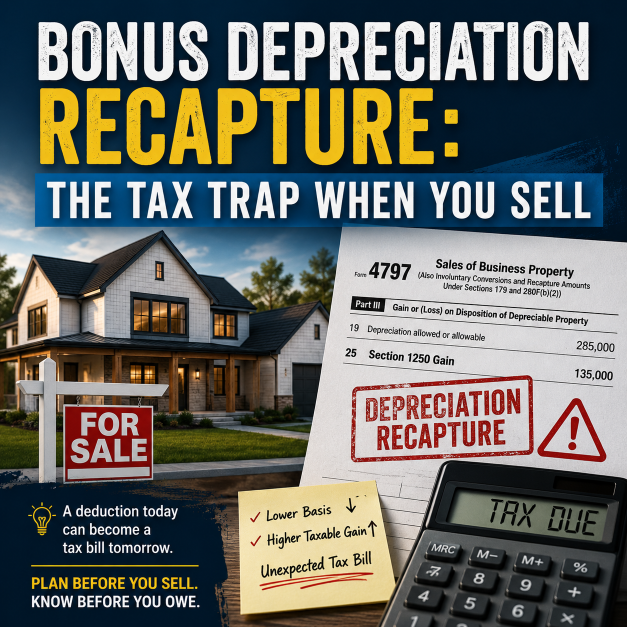
You purchased a rental property, completed a cost segregation study and claimed a large first-year deduction.
At the time, it felt like a win.
Your taxable income fell. You kept more cash. The advisor promoting the strategy looked brilliant.
But now the property is underperforming.
Rental income has declined. Insurance, utilities, repairs and management costs have increased. The mortgage is consuming the cash flow, and the property may be worth less than you paid.
You decide to sell—and discover that bonus depreciation recapture could contribute to a substantial tax bill.
How can you owe tax when the investment itself lost money?
Because cost segregation and bonus depreciation generally change the timing of your deductions. They do not change the economics of the investment, eliminate the debt or guarantee that the property will appreciate.
A large deduction today is not necessarily permanent tax savings.
Sometimes, it is simply a future tax bill that has not arrived yet.
What Is Bonus Depreciation Recapture?
Bonus depreciation recapture describes the tax consequences that may arise when property previously depreciated rapidly is later sold.
Cost segregation can separate portions of a property into shorter-lived asset categories, such as:
- Furniture and appliances
- Certain flooring and cabinetry
- Equipment
- Landscaping
- Fencing
- Parking areas
- Sidewalks
- Drainage systems
- Other qualifying land improvements
Those assets may qualify for accelerated depreciation, including bonus depreciation.
For qualifying property acquired and placed in service after January 19, 2025, current federal law generally provides a 100% first-year bonus depreciation deduction unless the taxpayer makes an applicable election. Eligible property generally includes MACRS property with a recovery period of 20 years or less; the residential or commercial building itself ordinarily does not become bonus-eligible merely because a cost segregation study was performed.
When those assets are sold, some or all of the resulting gain may be taxed as ordinary income under Section 1245 rather than receiving long-term capital-gain treatment. Special depreciation allowances, including bonus depreciation, are included in the depreciation potentially subject to Section 1245 recapture.
Cost Segregation Does Not Create Free Money
A cost segregation study generally accelerates deductions that otherwise would have been claimed over a longer period.
It can create meaningful value when:
- The taxpayer can use the deduction immediately.
- The deduction offsets income taxed at a relatively high rate.
- The property is expected to be held for many years.
- The underlying investment produces reliable cash flow.
- The tax savings are retained or invested productively.
- The eventual sale and recapture consequences have been modeled.
But it may produce a disappointing result when:
- The property is highly leveraged.
- The investor may need to sell within a few years.
- The property is already losing money.
- Market value declines.
- The deduction cannot currently be used.
- The investor spends the tax savings.
- The future tax cost was never evaluated.
The availability of a deduction does not make the underlying investment profitable.
A weak investment does not become a good investment merely because it generates a large tax loss.
The Hidden Danger of Heavily Leveraged Real Estate
Leverage can make the consequences of bonus depreciation far more painful.
Suppose an investor purchases a rental property primarily with borrowed money, claims accelerated depreciation and makes little progress paying down the loan.
When the property is sold:
- The lender must be repaid.
- Commissions and closing costs must be paid.
- Depreciation has reduced the property’s adjusted tax basis.
- The sale may create taxable gain and depreciation recapture.
- Repaying loan principal does not create a tax deduction.
This can create a serious mismatch between the investor’s taxable income and the cash remaining from the sale.
A Simplified Example
Assume the following:
| Item | Amount |
|---|---|
| Original property cost | $1,000,000 |
| Original debt | $800,000 |
| Depreciation claimed | $300,000 |
| Adjusted tax basis | $700,000 |
| Later sales price | $850,000 |
| Remaining loan payoff | $775,000 |
| Selling expenses at 6% | $51,000 |
The investor paid $1 million for the property and later sold it for $850,000.
Economically, the property declined by $150,000 before considering interest, operating losses and selling expenses.
For tax purposes, however, depreciation reduced the property’s adjusted basis to $700,000. Selling expenses also reduce the amount realized:
| Simplified tax calculation | Amount |
|---|---|
| Sales price | $850,000 |
| Less: selling expenses | ($51,000) |
| Net amount realized | $799,000 |
| Less: adjusted tax basis | ($700,000) |
| Total gain before determining tax character | $99,000 |
Although the property sold for less than its original purchase price, the investor may still recognize approximately $99,000 of taxable gain.
That does not mean the entire gain is taxed the same way. The sales price and adjusted basis must be allocated among the land, building, land improvements, furniture, appliances and other assets sold.
For illustration, assume the $99,000 gain is characterized as follows and taxed at the highest applicable federal rates:
| Illustrative gain allocation | Maximum federal rate | Estimated federal tax |
|---|---|---|
| $55,000 attributable to Section 1245 assets | 37% ordinary-income rate | $20,350 |
| $30,000 of unrecaptured Section 1250 gain | 25% | $7,500 |
| $14,000 of remaining Section 1231 gain | 20% long-term capital-gain rate | $2,800 |
| Estimated regular federal income tax | $30,650 |
If the entire $99,000 gain is also subject to the 3.8% net investment income tax, NIIT could add:
$99,000 × 3.8% = $3,762
The estimated total federal tax would then be:
$30,650 regular federal tax + $3,762 NIIT = $34,412
The full NIIT would apply only if the taxpayer has sufficient net investment income and modified adjusted gross income above the applicable threshold.
What Does the Investor Actually Keep?
The investor’s cash received at closing is calculated separately from the income-tax bill:
| Cash-flow calculation | Amount |
|---|---|
| Sales price | $850,000 |
| Less: loan payoff | ($775,000) |
| Less: commissions and closing costs | ($51,000) |
| Estimated cash received at closing | $24,000 |
The investor receives approximately $24,000 at closing but could later owe approximately $34,412 in federal tax, before considering state income taxes.
Under these assumptions, the federal tax bill alone exceeds the cash generated by the sale by approximately:
$34,412 − $24,000 = $10,412
The federal income tax is generally not paid through the real estate closing. It may instead require an estimated tax payment or be paid with the investor’s tax return.
The investor sold the property for $150,000 less than the original purchase price, received only about $24,000 after debt and selling expenses, and may still face a federal tax bill exceeding that amount because accelerated depreciation reduced the property’s adjusted basis.
That is the danger of combining:
- Heavy leverage
- Accelerated depreciation
- Falling property values
- Minimal principal reduction
- An early sale
The original deduction may have created valuable tax deferral. But when an underperforming property must be sold, the deferred tax can return when the investor has the least cash available to pay it.
A property can lose money economically while still producing taxable gain.
This is a simplified illustration. The actual tax depends on the allocation among land, building, land improvements and personal property; the investor’s ordinary and capital-gain rates; suspended passive losses; Section 1231 lookback rules; selling expenses; state taxes; and whether the net investment income tax applies. Selling expenses would also generally affect the amount realized and therefore the final taxable gain, so an actual transaction would require an integrated calculation rather than subtracting the full estimated tax and selling costs independently.
You Can Sell Below Your Purchase Price and Still Have Taxable Gain
Tax gain is not calculated simply by subtracting the original purchase price from the sales price.
In simplified form:
Amount realized − adjusted tax basis = taxable gain or loss
Depreciation reduces adjusted tax basis.
That means a property purchased for $1 million and sold for $850,000 can still generate taxable gain if depreciation has reduced its basis below $850,000.
The IRS generally requires depreciation that was allowed or allowable to be reflected in basis. Simply failing to claim a required depreciation deduction does not necessarily preserve basis for the future sale.
The actual calculation may also be affected by:
- Selling expenses
- Capital improvements
- Casualty adjustments
- Suspended passive losses
- Debt relief
- State depreciation differences
- Ownership structure
- Installment-sale treatment
- Prior like-kind exchanges
- The allocation of price among individual assets
A Real Estate Sale Is Often the Sale of Multiple Assets
A rental property is not necessarily treated as one indivisible asset for tax purposes.
It may contain:
- Nondepreciable land
- Section 1250 building property
- Section 1245 personal property
- Land improvements
- Furniture
- Appliances
- Equipment
- Intangible assets
Each category may have a different adjusted basis and tax character.
This is why “depreciation recapture” should not be estimated by multiplying total depreciation by a single tax rate.
The sale may produce several categories of income, each taxed differently.
Purchase-Price Allocations Matter at Acquisition and Sale
The allocation of the purchase price determines how much basis is assigned to:
- Land
- Building
- Land improvements
- Furniture and equipment
- Other personal property
The buyer and seller may have competing tax interests.
A buyer may prefer allocating more value to shorter-lived assets because those assets can be depreciated faster.
A seller may prefer allocating more value to land or building components because personal-property allocations may increase ordinary-income recapture.
That tension can make a negotiated written allocation particularly important.
If the parties agree to an allocation, the purchase agreement should clearly document it, and the buyer’s and seller’s tax reporting should remain consistent.
The same issue appears again when the property is sold.
The sales price must often be allocated among the transferred assets, and that allocation may significantly affect the seller’s depreciation recapture.
Do not assume that the original cost segregation percentages automatically determine the proper fair-market-value allocation years later. Asset values may have changed substantially during the ownership period.
The Installment-Sale Trap
Some investors assume that accepting payments over time will defer the entire tax bill.
That is not necessarily true.
When depreciated property is sold using the installment method, depreciation recapture generally must be recognized as ordinary income in the year of sale—even when the seller has not yet collected all the sales proceeds.
That can create another cash-flow mismatch:
- The buyer pays over several years.
- The seller recognizes recapture immediately.
- The seller may owe tax before collecting enough cash to comfortably pay it.
Installment terms should therefore be modeled before the agreement is signed.
Does Every Property Need an Expensive Cost Segregation Study?
No.
Cost segregation is a classification and documentation process—not a requirement that every investor purchase the most expensive engineering report available.
An engineering-based study may be appropriate for:
- Large apartment buildings
- Hotels
- Manufacturing facilities
- Medical facilities
- Major commercial properties
- Complicated construction or renovation projects
But the expense may not be justified for a small rental property.
The IRS recognizes several different cost-segregation approaches and maintains an Audit Techniques Guide for evaluating these studies. The taxpayer ultimately bears the burden of supporting the classifications and deductions claimed.
The decision should consider:
- Property size
- Expected deduction
- Marginal tax rate
- Ability to use the loss
- Study cost
- Audit risk
- Expected holding period
- Potential recapture
- State conformity
The objective is not to obtain the largest possible depreciation number.
It is to obtain a supportable result that improves the investor’s long-term, after-tax position.
What If You Never Completed a Cost Segregation Study?
An investor who previously classified nearly everything as building property may not necessarily have lost the opportunity forever.
Depending on the facts, previously missed depreciation may sometimes be corrected through Form 3115 and a Section 481(a) accounting-method adjustment.
This can allow the taxpayer to recognize a catch-up adjustment without amending every prior-year return.
However, claiming a large catch-up deduction shortly before selling the property may accelerate deductions immediately before the related assets produce recapture. That does not automatically make the strategy unwise, but it makes modeling the acquisition, catch-up deduction and exit together especially important.
Is Bonus Depreciation Mandatory?
For qualifying property, bonus depreciation generally applies unless the taxpayer properly elects out for the applicable class of property.
That creates an important planning question:
Should you claim the largest available deduction simply because the law allows it?
Sometimes the answer is yes.
Other times, regular depreciation may create a better match between:
- Current and future income
- Current and future tax rates
- Expected holding period
- Available losses
- Cash-flow needs
- Exit plans
- Estate-planning objectives
Tax software may calculate the maximum available deduction.
It cannot decide whether that deduction builds the most long-term wealth.
Airbnb and Short-Term Rental Losses Are Not Automatically Deductible Against W-2 Income
Purchasing a short-term rental does not automatically allow an investor to offset wages with a large depreciation loss.
The result may depend on:
- Average customer rental period
- Services provided to guests
- Material participation
- Basis limitations
- At-risk limitations
- Passive-activity rules
- Excess-business-loss limitations
- Personal use of the property
- Quality of the taxpayer’s time records
The strategy must be supported by the investor’s actual facts and participation.
A social-media post, realtor presentation or cost-segregation estimate is not enough.
Can Suspended Passive Losses Help When the Property Is Sold?
Possibly.
When an investor disposes of an entire interest in a passive activity in a fully taxable transaction to an unrelated buyer, suspended passive losses may generally be released.
Those losses can materially change the final tax result.
However, the calculation may be complicated by:
- Grouped activities
- Partial sales
- Related-party transactions
- Basis limitations
- At-risk limitations
- State differences
- Installment sales
- The character of the recognized gains
Suspended losses should be identified and modeled before the property is listed.
Can a 1031 Exchange Defer the Tax?
A properly structured Section 1031 exchange may defer qualifying gain from real property held for investment or business use.
But cost segregation can complicate the transaction.
A property may contain both Section 1250 real property and Section 1245 components. Depending on what is transferred and received, some recapture may be recognized or carried into the replacement property. IRS guidance explains that ordinary-income recapture can still arise in like-kind exchanges involving depreciated assets.
A 1031 exchange is also a deferral strategy—not a correction for a property that never made economic sense.
The transaction must be planned before closing, and preferably before the sale agreement is finalized.
Questions to Ask Before Claiming Bonus Depreciation
Before completing a cost segregation study or claiming bonus depreciation, ask:
- Can I actually use the deduction this year?
- What type of income will it offset?
- What tax rate applies to that income?
- How long do I realistically expect to hold the property?
- What happens if rental income declines?
- What happens if the property falls in value?
- How much debt will remain when I sell?
- How will depreciation affect my adjusted basis?
- What portion could become Section 1245 ordinary-income recapture?
- Could the sale create taxable income without enough cash to pay it?
- What will I do with the cash preserved by the deduction?
- Would electing out of bonus depreciation improve the long-term result?
- What state tax adjustments apply?
- Is the cost of the study justified?
- Has anyone modeled the exit—not just the first-year deduction?
The most important question may be:
Would I still buy this property if the tax deduction did not exist?
If the answer is no, the tax strategy may be influencing the investment decision more than the property’s economics.
Already Claimed Bonus Depreciation and Thinking About Selling?
Do not wait until after closing to calculate the tax consequences.
Gather:
- Original closing statement
- Purchase agreement and allocation
- Cost segregation report
- Fixed-asset and depreciation schedules
- Prior tax returns
- Improvement records
- Current debt payoff
- Expected selling expenses
- Suspended-loss schedules
- Proposed sales agreement
- Proposed asset allocation
- State depreciation adjustments
Then model:
- Estimated gross sales proceeds
- Debt payoff
- Transaction costs
- Adjusted basis by asset
- Section 1245 recapture
- Unrecaptured Section 1250 gain
- Released passive losses
- Federal tax
- State tax
- Estimated cash remaining after tax
The final number that matters is not the deduction you received when you purchased the property.
It is the cash and wealth you retain after the entire investment has run its course.
The Largest Deduction Is Not Always the Best Strategy
Cost segregation and bonus depreciation can be valuable tools.
But tools do not replace judgment.
A first-year deduction is easy to calculate, easy to advertise and emotionally rewarding.
Long-term tax planning is harder.
It requires looking beyond the current return and considering leverage, cash flow, future tax rates, recapture, exit timing and the investor’s broader financial goals.
The goal is not to generate the largest deduction possible.
The goal is to make the best long-term decision for your property, your wealth and your family.
Frequently Asked Questions About Bonus Depreciation Recapture
Do I have to repay all the bonus depreciation when I sell?
Not necessarily. Depreciation recapture is not always a dollar-for-dollar repayment of the deduction.
The result depends on:
- The selling price allocated to each asset
- The adjusted basis of each asset
- The amount of depreciation allowed or allowable
- Whether the asset is Section 1245 or Section 1250 property
- Other gains, losses and selling expenses
Shorter-lived personal property identified in a cost segregation study may generate ordinary-income recapture under Section 1245. The building portion may receive different treatment.
Can I owe depreciation recapture if I sell the property for less than I paid?
Yes.
Depreciation reduces your adjusted tax basis. Therefore, a property sold for less than its original purchase price can still generate taxable gain if the sales price exceeds its reduced adjusted basis.
This is especially concerning when the property is heavily financed because the lender must be repaid even though loan-principal payments are not deductible.
What is phantom income when selling rental property?
Phantom income generally means taxable income that is not accompanied by enough available cash to pay the resulting tax comfortably.
For example, a sale may create taxable gain because depreciation reduced the property’s basis. But most of the sale proceeds may be used to repay the mortgage and cover commissions or closing costs.
The investor can therefore owe tax even though very little cash remains after the sale.
Does cost segregation increase my total depreciation deduction?
Generally, cost segregation changes the timing of depreciation rather than creating unlimited additional deductions.
It identifies property components that may qualify for shorter recovery periods. This allows some deductions to be claimed sooner rather than depreciating nearly everything with the building over 27.5 or 39 years.
Is bonus depreciation mandatory?
Bonus depreciation generally applies by default to qualifying property unless the taxpayer properly elects out for the applicable property class.
The better question is not merely whether bonus depreciation is available. It is whether claiming it immediately creates the best long-term result.
Can I choose how much bonus depreciation to claim?
A taxpayer generally cannot simply select an arbitrary percentage for one qualifying asset.
The taxpayer may generally claim bonus depreciation or elect out for an entire class of qualifying property placed in service during the year. Other depreciation elections and planning alternatives may still affect the overall deduction.
Can an Airbnb cost segregation loss automatically offset W-2 income?
No.
The answer depends on the average rental period, material participation, basis, at-risk rules, passive-activity rules, personal use and other limitations.
Buying a short-term rental and completing a cost segregation study does not automatically make the resulting loss deductible against wages.
What happens to suspended passive losses when I sell?
Suspended passive losses may generally be released when the taxpayer sells their entire interest in the passive activity through a fully taxable transaction to an unrelated buyer.
However, related-party sales, installment sales, grouped activities, partial dispositions and basis or at-risk limitations can complicate the result.
Can a 1031 exchange defer bonus depreciation recapture?
A properly structured Section 1031 exchange may defer some taxable gain associated with qualifying real property.
However, cost segregation may identify Section 1245 personal-property components that do not receive the same treatment as real property. The exact result depends on the assets transferred, the replacement property and the transaction structure.
A 1031 exchange should be planned before the property is sold—not after a taxable sale has already occurred.
Does an installment sale defer depreciation recapture?
Generally, depreciation recapture must be recognized in the year of sale even when the remaining sale proceeds will be collected over time.
This can create a cash-flow problem because the seller may owe tax before receiving all the payments from the buyer.
Does every rental property need a cost segregation study?
No.
A detailed engineering-based study may make sense for a large or complicated property, but the cost may outweigh the tax benefit for a small rental.
Cost segregation studies are generally more suitable for larger projects and may be cost-prohibitive for smaller properties.
The decision should consider the study cost, expected deduction, tax rate, holding period, ability to use the loss and potential recapture.
What if I failed to claim the correct depreciation in prior years?
In some situations, missed depreciation can be corrected using Form 3115 and a Section 481(a) accounting-method adjustment rather than amending every prior return.
The source material specifically notes that property initially allocated only between land and building may sometimes be corrected later through an accounting-method change.
This should be evaluated carefully when a sale is approaching because a catch-up deduction may be followed shortly by depreciation recapture.
Does the original cost segregation allocation control when I sell?
Not necessarily.
The cost segregation study generally allocates the property’s original cost when it is acquired or improved. At sale, the consideration may need to be allocated based on the assets’ values at that later date.
Furniture, equipment, land improvements, the building and land may not appreciate or depreciate at the same rates.
Can the buyer and seller agree on an asset allocation?
Yes, and a written allocation can be important.
Buyers and sellers often have adverse tax interests: the buyer may prefer more value assigned to rapidly depreciable assets, while the seller may prefer allocations that reduce ordinary-income recapture.
The source material notes that courts and the IRS generally respect reasonable written allocations negotiated by parties with adverse tax interests.
What should I give my CPA before selling the property?
Provide:
- The original closing statement
- Purchase and sale agreements
- Cost segregation report
- Fixed-asset and depreciation schedules
- Prior-year tax returns
- Records of later improvements
- Current mortgage payoff
- Expected commissions and selling costs
- Suspended passive-loss information
- Proposed sales-price allocation
- State depreciation schedules
Your CPA should calculate more than the projected taxable gain. The analysis should estimate how much cash you will retain after debt, transaction costs, federal tax and state tax.
Thinking About Selling a Property After Claiming Bonus Depreciation?
Before accepting an offer, understand how adjusted basis, depreciation recapture, suspended losses, debt payoff, selling expenses and state taxes could affect the cash you actually keep.
Corridor Consulting can help you evaluate the potential tax consequences before the transaction is completed.
