
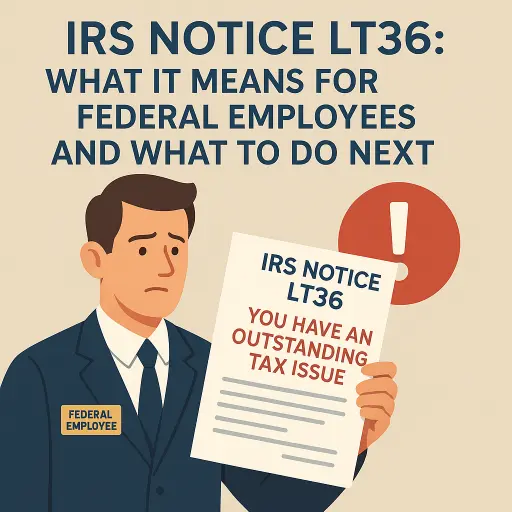
If you’re a current or retired federal employee and you just received IRS Notice LT36, it can feel like a double gut punch: one, the IRS says you have a tax problem; two, the letter hints that you’re failing to “set an example.”
Underneath the guilt-laced language, LT36 is simply this:
an urgent reminder that the IRS believes you have an unresolved tax issue—and that it expects you to fix it before consequences get more serious.
In this guide, we’ll walk through:
- What IRS Notice LT36 is and why you received it
- How each section of the notice works
- Practical steps you can take to correct errors, stop penalties from snowballing, and resolve the debt
IRS Notice LT36 at a Glance
Here’s how to think about LT36 in plain English:
- Notice type: Urgent reminder / escalation notice
- Generated by: IRS ACS (Automated Collection System) Support
- Typical sequence:
- Sent after at least one prior LT or CP notice
- Often before more serious enforcement steps
- Message: You have a tax issue that needs prompt action
- Recommended response:
- File any missing returns
- Confirm that the IRS balance is correct
- Pay in full if possible, or enter a formal resolution (payment plan, offer in compromise, hardship status, etc.)
LT36 is the IRS telling you, “We still have a problem—and we expect you to address it now.”
IRS Notice LT36, Section by Section
Part 1: “You Have an Outstanding Tax Issue”
LT36 usually opens by thanking you for your federal service, then immediately reminding you that:
Everyone is responsible for paying taxes on time, and current or retired federal employees should “lead by example.”
The letter then warns that if you don’t resolve your outstanding tax issue, the IRS will continue to pursue the matter directly.
You may also see language referencing Congress and the importance of federal employees complying with tax law. It’s designed to apply pressure. The key takeaway is not the guilt—it’s that the IRS expects a concrete response.
Part 2: What the IRS Wants You To Do Right Away
Next, the notice moves into action items, typically along these lines:
- File any delinquent returns the IRS lists
- Pay your outstanding balance using one of several methods
- If you cannot pay in full, consider a payment plan
Usually, the letter will mention:
- How to pay and file online through IRS systems
- That you can apply for an installment agreement if full payment isn’t realistic
This part is all about “resolve the debt or show us how you intend to.”
Part 3: If You Believe the IRS Is Wrong
There’s usually a brief section acknowledging that the IRS can make mistakes and that you should:
- Verify that the balance is actually correct
- Contact the IRS if you believe the notice is wrong
The notice will provide a phone number and sometimes instructions about which line to call depending on the nature of the dispute (balance vs. penalties).
The IRS doesn’t walk you step-by-step through that process—that’s where a qualified advisor can help—but it does concede that you have the right to challenge errors.
What To Do If You Receive IRS Notice LT36
Here’s a step-by-step framework you can follow.
Step 1: Confirm That You Really Owe What the IRS Says You Owe
Before you worry about payment plans or tax relief, start with accuracy.
Ask yourself:
- Do the years and tax forms listed match what you’ve filed?
- Did you previously receive notices about these same balances?
- Do the amounts line up with your own records and returns?
Pull together:
- Copies of the returns for the years listed
- Any prior IRS notices
- Your own documentation (W-2s, 1099s, K-1s, etc.)
Sometimes the issue is simply that the IRS has not properly updated your account—or that it used incomplete or incorrect data to compute the balance. Your job is to verify, not just trust.
Step 1a: Dispute the Balance If the IRS Is Wrong
If your review shows that something is off:
- Use the phone number on the notice to call the IRS about the balance itself.
- Be ready to explain specifically what you believe is wrong and why.
- Have your returns, notices, and supporting documents in front of you during the call.
It’s rare for everything to be fixed in a single conversation. You may need to:
- Call more than once
- Speak with more than one representative
- Send in documents by mail or fax
The process can be frustrating, but acting quickly helps limit further penalties and interest. Many taxpayers prefer to have a CPA firm handle these calls and correspondence on their behalf to avoid repeating their story multiple times.
Step 2: If You Can Pay in Full, Consider Doing So
If the balance is correct and you have the resources to pay in full:
- Paying off the tax debt stops new failure-to-pay penalties from accruing.
- Interest will stop increasing on the amount you’ve paid.
- You remove the risk of more serious collection actions down the road.
For some taxpayers, the cleanest, least stressful option is to simply pay the IRS and be done—especially if the balance is manageable compared to their overall financial picture.
Step 3: Explore Penalty Relief (Penalty Abatement)
If you can’t comfortably pay in full—or if a large share of the balance is penalties—it may be worth exploring penalty abatement.
Penalty relief can:
- Remove some or all of certain penalties, or
- Reduce the total enough to make a payment plan or lump-sum payment more realistic.
Common avenues include:
- First-time abatement, if you have a clean compliance history in prior years
- Reasonable cause arguments, such as serious illness, natural disaster, or other circumstances outside your control
Not everyone qualifies, and the IRS doesn’t grant every request, but for many taxpayers it’s an important part of the strategy.
Step 4: Look at Your Tax Relief and Resolution Options
If you’ve verified the balance and addressed any possible penalty relief, the next step is to decide how to resolve what remains.
Some of the most common options:
1. Installment Agreement (Payment Plan)
- You agree to pay a set amount each month until the balance is paid.
- The IRS may allow a streamlined agreement if you’re under certain balance thresholds and meet basic filing requirements.
- Penalties and interest may still accrue, but you avoid more aggressive enforcement as long as you keep up with payments.
2. Offer in Compromise (OIC)
- In some cases, the IRS may accept less than the full amount if your financial situation shows that you cannot reasonably pay in full.
- The IRS reviews your income, expenses, assets, and equity to determine whether an offer is acceptable.
- It’s a powerful tool when appropriate, but many taxpayers don’t qualify—and it must be carefully prepared.
3. Currently Not Collectible (CNC) Status
- If paying anything right now would cause significant financial hardship, the IRS may temporarily mark your account as currently not collectible.
- Active collection efforts pause, but interest and penalties can continue to accrue.
- CNC is often a bridge strategy while you stabilize your finances or consider longer-term options.
A thoughtful resolution plan considers your actual financial life, not just what the IRS’s online payment options suggest.
Why Federal Employees Need a More Thoughtful Approach
For current and retired federal employees, an IRS Notice LT36 isn’t just about the numbers. Unresolved tax debt can raise additional concerns:
- Employment or clearance questions
- Professional reputation
- Stress about being seen as “non-compliant”
That’s why it’s important not to simply:
- Ignore the letter, or
- Sign up for the fastest online payment plan without first confirming that the balance is accurate
A careful review of your past returns, records, and penalties may uncover errors and opportunities that significantly change your best path forward.
Why Many Tax Relief Firms Don’t Go Far Enough for Federal Employees
When a notice like LT36 lands, many people quickly call a heavily advertised tax relief company. For simple situations, those firms might help push paperwork through or set up a basic payment plan. But for current and retired federal employees, that surface-level approach often isn’t enough—and sometimes leaves serious issues unresolved.
Here are a few limitations we see again and again:
- They often accept the IRS’s numbers at face value.
Many tax relief outfits start from whatever the IRS shows on transcripts and prior returns. They rarely ask whether those returns were prepared correctly in the first place or whether the balances could be reduced by fixing errors. - They usually don’t dig into the problem years.
There’s often no detailed review of past filings, no reconstruction of income and deductions, and no real analysis of elections, withholding, or how your payroll and retirement contributions interact with your tax picture. The focus is “how do we get a deal?” instead of “are these balances even right?” - They aren’t built for nuanced federal-employee situations.
Federal workers may have unique pay structures, benefits, retirement accounts, and—sometimes—sensitivity around clearances or internal agency expectations. Call-center style tax relief firms are rarely set up to think about those downstream consequences. - They focus on forms and phone calls, not long-term stability.
You may get help with an installment agreement or an offer in compromise request, but you’re often left with the same underlying bookkeeping, withholding, and filing habits that led to the problem. That almost guarantees future issues.
By contrast, our starting point is different:
We ask whether the returns and balances behind Notice LT36 are accurate, and what needs to change so this doesn’t happen again.
That usually means:
- Reviewing and, when appropriate, amending prior returns
- Cleaning up the underlying records so your numbers are defensible
- Looking at your broader financial and employment context—not just what the IRS system shows today
For federal employees, real tax relief isn’t just “getting the IRS off your back this year.” It’s making sure the math is correct, the filings are solid, and the plan you choose fits your job, your family, and your long-term financial life.
How Our Firm Helps with IRS Notice LT36
At Corridor Consulting, we treat an IRS Notice LT36 as both:
- A risk—if ignored or handled hastily, and
- An opportunity to clean up the past and prevent future issues
For clients who come to us with LT36, we typically:
- Analyze the notice and transcripts
- Pull IRS transcripts for the years in question
- Confirm what the IRS believes you owe and why
- Verify the underlying returns and balances
- Compare your returns and books to the IRS’s numbers
- Identify filing gaps, misclassifications, or missed deductions
- Recommend amending returns when doing so reduces risk and aligns the numbers with reality
- Develop a resolution strategy
- Evaluate payment in full, installment agreements, offers in compromise, hardship status, and penalty relief
- Help you understand the trade-offs between options
- Help you stay out of trouble going forward
- For business owners, transition you into our 90-Day Pathway to Prosperity™ onboarding, where we:
- Clean up and organize your accounting
- Put reliable systems in place
- Teach you how to read and use your financials so surprises are less likely in the future
- For business owners, transition you into our 90-Day Pathway to Prosperity™ onboarding, where we:
Our goal is not just to “deal with the letter” but to help you move from reactive crisis mode to proactive, long-term financial clarity.
Key Takeaways
- IRS Notice LT36 is an urgent reminder aimed at current and retired federal employees that the IRS believes you have an unresolved tax issue.
- It typically follows at least one earlier notice and warns that you need to resolve your account before more serious consequences follow.
- Your first step is to verify that the balance and years listed are correct—never assume the IRS is automatically right.
- If the balance is accurate, you can consider paying in full, exploring penalty relief, or entering a structured resolution such as an installment agreement, offer in compromise, or currently not collectible status.
- A careful, CPA-led review of your returns and records often uncovers errors and opportunities that generic “tax relief” approaches overlook.
You don’t have to navigate IRS Notice LT36 alone—and you don’t have to let one letter define your financial future.
Take the First Step
If you’ve received IRS Notice LT36 or another collection notice and want clarity on your options:
Complete our Discovery Chat Questionnaire to begin your complimentary consultation.
During this initial conversation, we’ll discuss your situation, answer your questions, and determine whether a full Case Evaluation is appropriate.
If you choose to move forward with a Case Evaluation, our team will pull and analyze your IRS transcripts, confirm the accuracy of your balance, identify possible errors, and outline the resolution strategies available to you.
This keeps you fully informed before deciding how to proceed—without committing to any services upfront.
Additional IRS & Official Resources
For more detail straight from official sources:
- Payment Plans and Installment Agreements – IRS
Overview of options to pay your tax bill over time, including short-term and long-term payment plans. - Online Payment Agreement Application – IRS
Apply online for a payment plan if you can’t pay your full balance today. - IRS Penalties: Failure to File and Failure to Pay
Official explanations of late-filing and late-payment penalties and how they’re calculated. - Taxpayer Bill of Rights / Your Rights as a Taxpayer
Learn your fundamental rights when dealing with the IRS, including the right to challenge the IRS’s position and be heard. - Topic No. 653 – IRS Notices, Bills, Penalties and Interest
IRS topic page summarizing how notices work and how penalties and interest accrue.
