
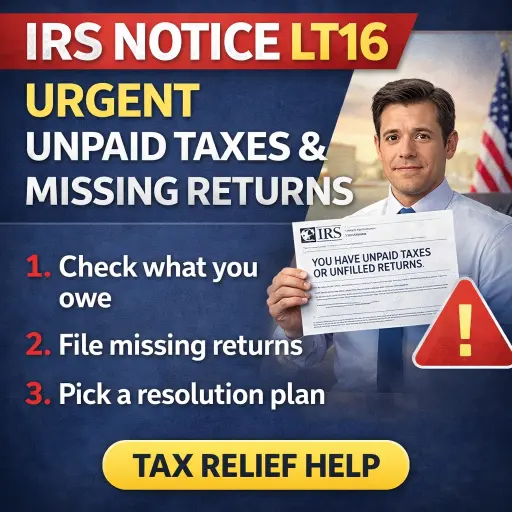
IRS Notice LT16 is a reminder letter the IRS sends when it believes you need to take action on your account. For some people, it’s strictly about a balance due. For others, it’s about both unpaid taxes and missing tax returns—often called a “combo account.”
Either way, LT16 is the IRS saying: let’s get this moving—by paying, setting up a plan, or filing what’s missing so you can qualify for resolution options.
This article explains LT16 in plain English and gives you a clear, calm game plan to respond.
IRS Notice LT16 At a Glance
| Item | What it means |
|---|---|
| Official name | “You Have Unpaid Taxes or Unfiled Returns” letter |
| Notice type | Reminder / contact attempt |
| Generated by | IRS ACS Support (Automated Collection System) |
| Common triggers | Balance due not resolved, and/or missing returns |
| Can apply to | Balance-due accounts and “combo accounts” |
| Recommended action | File required missing returns and choose a resolution path |
| IRM reference | IRM 5.19.5 (ACS Inventory) |
IRS Notice LT16 Explained, Part by Part
LT16 formats can vary, but the sections typically cover the same themes: what the IRS says you owe, what’s missing, and how to respond.
Part 1: The IRS wants you to take action on IRS Notice LT16
The opening message is usually a prompt to address:
- unpaid taxes, and/or
- unfiled returns
Some LT16 letters show a clear total balance. Others use more general wording and push you to review the detailed breakdown later in the notice. The tone is often “please act” rather than a hard demand—but it’s still a serious letter because it’s tied to the IRS collections workflow.
Part 2: What the IRS says to do right away
This section typically lists your main paths:
- Pay the balance in full (fastest way to stop ongoing charges)
- Set up a payment arrangement
- Make a partial payment if full payment isn’t possible immediately
- Review options if you can’t pay due to financial hardship
- If you have missing returns: file them promptly (often with a short time window)
If your account is a combo account, the filing message matters because many IRS relief options require you to be current on filing.
Part 3: Where the IRS says to learn more
LT16 often points taxpayers to an IRS notice information page. In practice, that page usually summarizes what the letter already says. The most important details are still:
- the tax periods listed, and
- the specific instructions on your letter
Part 4: Billing summary by tax year
Most LT16 notices include a table listing what the IRS believes you owe by period. Typical columns include items like:
- Tax period ending (the year or quarter involved)
- Form type (the return that created the balance, or an IRS-prepared return in some cases)
- Tax assessed
- Penalties
- Interest
- Total
This is the section you should scrutinize. It’s possible for a year to be listed incorrectly, for payments to be missing, or for penalties to be overstated due to processing issues.
Part 5: List of missing returns
If the IRS believes you have unfiled returns, LT16 may show a list of years it expects.
Important note: the IRS’s list isn’t always perfect, and “file everything on the list” isn’t always the best first move without context. For many resolution pathways, the IRS typically wants you to be compliant for the most recent years. A CPA can help you prioritize what’s required for your goals and avoid wasted effort.
Part 6: If you can’t pay due to hardship
LT16 commonly mentions options when payment isn’t realistic right now. Two concepts often show up:
- Temporary collection hold due to hardship (commonly associated with “currently not collectible” status when appropriate)
- Settle for less than the full amount (commonly associated with an Offer in Compromise, if you qualify)
These programs have strict rules, and not everyone qualifies. But this section is the IRS acknowledging that “pay in full” is not the only path.
Part 7: Contact and help information
This section provides IRS contact channels and basic administrative guidance. If you do call, use the number printed on your notice whenever possible.
Part 8: Taxpayer rights and assistance resources
LT16 typically references taxpayer rights and general assistance options such as:
- the Taxpayer Bill of Rights
- IRS Publication 1
- the Taxpayer Advocate Service
- Low Income Taxpayer Clinics (when applicable)
Part 9: Payment coupon
Many LT16 letters include a detachable payment stub for mailing a payment. If you mail a payment, accurate identifiers matter so the IRS applies it to the correct tax period.
When the IRS Sends Notice LT16
LT16 is commonly issued when:
- the IRS shows an unresolved balance due, and you haven’t set up a plan, and/or
- the IRS shows missing returns and needs you to file so the account can be addressed
If you’ve moved recently, it’s also possible that earlier letters didn’t reach you—so LT16 might feel like the “first” notice even if it isn’t.
What You Should Do If You Receive IRS Notice LT16
Step 1: Verify the IRS Notice LT16 is accurate
Before paying or committing to a plan, confirm:
- the tax years listed are correct
- payments you made are reflected
- the balance breakdown (tax, penalties, interest) makes sense
- the missing return years are actually missing
If something looks off, don’t assume the IRS is right—errors do happen.
Step 2: Fix any problems in the IRS numbers
If you disagree with the total or specific line items:
- gather your proof (copies of returns, payment confirmations, transcripts, prior IRS letters)
- call the number on the notice to discuss the discrepancy
If the issue is technical (misapplied payment, missing withholding credit, incorrect penalty computation), CPA support can speed up the resolution because the IRS often needs a clear, documented explanation.
Step 3: Get filing compliance in place
If LT16 lists unfiled returns, your best next step is usually to:
- identify which returns must be filed to qualify for the resolution you need, and
- file those returns accurately and promptly
This is especially important for combo accounts. Most IRS resolution programs require you to be current with required filing before the IRS will finalize relief or long-term payment arrangements.
Step 4: Choose the right resolution option
Once the numbers are correct and filing is addressed, you’ll generally choose one of these paths:
- Pay in full (stops additional interest/penalties going forward)
- Installment agreement (monthly plan based on what the IRS will accept and what you can afford)
- Hardship-based relief when payment is not currently possible (depending on your financial situation)
- Settlement options (only if you qualify, and only after careful analysis)
The right approach depends on your total balance, income, assets, and whether you have missing returns still in play.
Why Work With a CPA Firm, Not Just a Tax Relief Company
LT16 cases often involve a mix of issues: balances, penalties, missing returns, and IRS collection workflow. That’s where a CPA firm can be a safer fit than a “tax relief mill.”
A CPA firm can help you:
- validate the IRS numbers with documentation and transcripts
- prepare missing returns correctly (especially with self-employment or small business income)
- evaluate realistic resolution options based on your finances
- build an ongoing compliance plan so you don’t end up back in the same cycle
How Corridor Consulting CPAs Can Help With IRS Notice LT16
Corridor Consulting CPAs helps individuals and small businesses in Cedar Rapids, Eastern Iowa, and nationwide by:
- reviewing LT16 for accuracy and identifying what the IRS is actually demanding
- prioritizing which missing returns must be filed to move forward
- preparing and filing back returns (with a focus on accuracy and audit-sensible documentation)
- seeking penalty relief when appropriate
- setting up a sustainable resolution strategy—payment plan, hardship pathway, or other options depending on eligibility
We’re a CPA firm built for both tax resolution and long-term support—so your plan is designed to stick.
Take the First Step Toward IRS Tax Relief
If you received LT16, you don’t need to panic—but you do want to act deliberately. A clear response can prevent the account from escalating and help you move into a workable resolution.
If you want professional guidance, Corridor Consulting CPAs can help you interpret the letter, correct errors, file what’s needed, and choose a realistic path forward—starting from Cedar Rapids and serving clients across the U.S.
