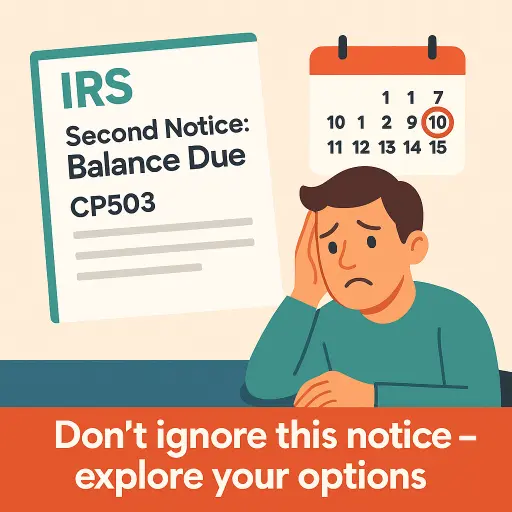
Getting an envelope from the IRS labeled “Notice CP503 – Second Notice” is unsettling, even if you already know you owe back taxes. This letter means the IRS has tried to contact you about a balance due and still hasn’t received payment or a response. It’s a warning that your account is moving deeper into the collection process.
In this guide, we’ll break down IRS Notice CP503 section by section, explain what the IRS is telling you, and walk through practical steps to protect yourself before things escalate to liens, levies, or wage garnishment.
IRS Notice CP503 at a Glance
- Notice type: Collections – second reminder of balance due
- Generated by: IRS Automated Collection System (ACS)
- Typically preceded by: CP501 (first balance due reminder)
- Often followed by: CP504 (urgent notice that can precede levy)
- Recommended action: Confirm the balance and enter into a resolution (pay, payment plan, or other relief)
Inside IRS Notice CP503, Part by Part
1. Billing Summary – How the IRS Calculates Your Balance
The first page of IRS Notice CP503 includes a billing summary that shows how the IRS arrived at your current balance. For each tax year, you’ll generally see lines such as:
- Amount you owed: The original tax the IRS says you owe for that return or assessment.
- Payments and credits: Any withholding, estimated tax payments, or payments you’ve made since filing. (If you haven’t paid anything, this line may be blank.)
- Penalties: Late-filing, late-payment, or estimated tax penalties the IRS has added.
- Interest: Ongoing interest charged on unpaid tax and penalties.
Together, these items add up to the “Total amount you owe” line on the notice.
Don’t assume the numbers are correct—this is where you start checking the IRS’s math against your own records.
2. What the IRS Wants You to Do Right Now
The next section of IRS Notice CP503 describes what the IRS expects from you. In plain language, the letter is saying:
Pay the balance in full within about 10 days, or contact us to set up a payment arrangement.
Typically, this section:
- Urges you to pay immediately using the online payment portal, check, or money order.
- Mentions the option to request an installment agreement if you can’t pay everything at once.
- Points you to your online IRS account to view updated balances and payment history.
Even though the tone is firm, this is still a warning stage—you generally still have time to fix things before the IRS begins enforced collection.
3. What Happens If You Ignore IRS Notice CP503
Later in the notice, the IRS explains what may happen if you don’t respond.
Common consequences listed in a CP503 include:
- Additional penalties and interest added to your balance.
- Possible filing of a Notice of Federal Tax Lien, which can affect your creditworthiness and public records.
- Potential forced collection actions, such as:
- Wage garnishment (up to the legal limit)
- Bank account levies
- Offsets of future refunds
The CP503 itself is not a final levy notice—but it often comes just before the more serious CP504 or other levy-intent letters if you continue to ignore the debt.
4. Penalties Shown on IRS Notice CP503
The penalties section of IRS Notice CP503 lists each penalty type that has been assessed, along with a short description. For many taxpayers, this includes:
- Failure-to-pay penalty – generally 0.5% per month of the unpaid tax, up to a cap.
- Possibly failure-to-file penalty – much steeper, typically 5% per month if you filed late.
- Estimated tax penalty – effectively interest for failing to make adequate estimated payments throughout the year.
These charges can snowball quickly, especially when combined with IRS interest. However, in some situations they can be reduced or removed—more on that below.
5. Penalty Relief Information
Many versions of IRS Notice CP503 include a short paragraph explaining that penalties may be reduced or removed in certain circumstances.
This is the IRS’s brief nod to:
- First-time abatement (for taxpayers with a clean recent history), and
- Reasonable cause relief (serious illness, natural disaster, or other significant hardship).
The notice doesn’t walk you through how to request relief or what evidence is helpful—that’s where professional guidance is often critical.
6. Interest Calculation by Quarter
Finally, IRS Notice CP503 provides a breakdown of interest charged on your account, often by quarter:
- The IRS lists each period with the applicable interest rate.
- It then shows how much interest accrued during each period based on your outstanding balance.
Interest continues to run until the entire balance (tax + penalties) is paid, which is one reason delaying action can dramatically increase the cost of your tax problem.
When and Why the IRS Sends Notice CP503
You’ll usually receive IRS Notice CP503 when:
- You filed a tax return that showed a balance due,
- You did not pay that balance in full, and
- The IRS already sent a CP501 and didn’t receive payment or a meaningful response.
Other common scenarios include:
- The IRS filed a Substitute for Return (SFR) for you because you didn’t file, then assessed tax and began collection.
- You did pay the original balance, but paid late, triggering penalties and interest you haven’t yet addressed.
- The IRS misapplied or failed to post one of your payments correctly, creating what looks like an unpaid balance.
In short, CP503 is the IRS saying: “We told you there’s a balance due. We still haven’t seen payment. We are moving closer to enforced collection.”
What To Do If You Receive IRS Notice CP503
Step 1: Verify That IRS Notice CP503 Is Correct
Start by comparing the notice to your own records:
- Pull the tax return for the year in question.
- Review cancelled checks, bank statements, and wage/withholding information.
- Make sure all payments you’ve made have actually been credited.
Questions to ask:
- Does the “Amount you owed” match the tax on your filed return or the assessment you expected?
- Are there payments missing that you know you sent?
- Do the penalties and dates roughly match your filing and payment history?
If the numbers don’t add up, don’t just shrug and pay—errors do happen.
Step 2: Contact the IRS to Correct Any Errors
If you believe there’s a mistake:
- Use the phone numbers listed in IRS Notice CP503:
- One number is usually provided in the “What you need to do immediately” section for general questions and balance disputes.
- Another may be listed near the penalty section for detailed penalty calculations.
Have this ready when you call:
- A copy of the CP503 notice
- Your tax return(s) for the year
- Proof of payments (checks, online confirmations, bank statements)
Be prepared for more than one phone call. If you’d rather not spend hours on hold, a professional (CPA or tax attorney) can handle this on your behalf.
Step 3: Explore Penalty Abatement
For many taxpayers, penalties make up a painful chunk of the balance. In appropriate cases, we look for ways to reduce them.
Common forms of penalty relief include:
- First-time abatement – available if you’ve been compliant for the prior three years and meet certain criteria.
- Reasonable cause relief – for situations such as serious illness, natural disasters, records destroyed, or other circumstances beyond your control.
While penalty abatement isn’t guaranteed, it’s often worth pursuing—especially when balances have built up over several years.
Step 4: Decide How You’ll Handle the Remaining Balance
Once you’ve:
- Confirmed the numbers, and
- Pursued any available penalty relief,
you need a plan for the remaining balance.
Common options:
- Pay in full.
- Stops new penalties and interest going forward.
- Set up an installment agreement.
- Pay the balance over time; the IRS may still charge interest and some penalties, but you avoid enforced collection if you stay current.
- Offer in Compromise (OIC).
- In qualifying cases, the IRS agrees to accept less than the full amount owed based on your ability to pay.
- Currently Not Collectible (CNC) status.
- The IRS temporarily pauses collection because your financial situation doesn’t allow payment after basic living expenses.
Choosing the right option depends on your income, assets, household needs, and long-term goals—not just what the notice suggests in a few lines of text.
Why Many “Tax Relief” Firms Don’t Go Far Enough
When a CP503 notice lands, many people call a national “tax relief” company they saw in an ad. Some of these firms can fill out forms and talk to the IRS, but for complex situations, that often isn’t enough. You need a CPA Firm.
Common limitations we see:
- Little or no review of the underlying returns.
They often accept the IRS numbers—or your prior accountant’s filings—as correct and move straight to negotiating payment terms. - No deep dive into your books or entity structure.
For business owners, S corporations, partnerships, and multi-entity structures, issues like basis, depreciation, and reasonable compensation matter. Call-center style firms rarely go that deep. - Focus on “payment plans” instead of total strategy.
They may be good at submitting forms, but don’t always help you:- Amend incorrect returns
- Rebuild clean books
- Fix structural problems that created the issue in the first place
At Corridor Consulting, our starting question is different:
“Is the IRS balance on your CP503 based on accurate, defensible returns?”
In many cases, we find:
- Returns that should be amended
- Deductions or elections that were handled incorrectly
- Bookkeeping that doesn’t match what’s on the tax return
Fixing those issues first can lower the balance, reduce long-term risk, and give you a stronger position when we negotiate with the IRS.
How Our CPA Firm Helps With IRS Notice CP503
At Corridor Consulting, we treat IRS Notice CP503 as more than a bill—it’s a signal that your tax situation needs both immediate triage and long-term cleanup.
Here’s how we typically approach these cases:
1. Immediate Triage and Transcript Review
- Pull and review your IRS transcripts for all affected years.
- Confirm what the IRS has on file for returns, assessments, and payments.
- Map out which notices have already been issued and what might come next (CP504, levy notices, etc.).
2. Verify the Numbers and Returns
We don’t just assume the CP503 is right. We:
- Compare IRS balances to your returns and accounting records.
- Identify missing payments, misapplied credits, or obvious errors.
- Review the original tax returns to see if amendments could:
- Correct mistakes
- Claim missed deductions
- Align the tax reporting with how your business actually operates
If amending prior returns makes sense, we’ll recommend a plan that balances risk, savings, and timing.
3. Design a Resolution Strategy That Fits Your Situation
Once the numbers are accurate and we understand your bigger picture, we help you choose the best path:
- Installment agreement planning that fits real cash flow.
- Penalty abatement requests where justified.
- Offer in Compromise evaluation if your financial situation qualifies.
- CNC (hardship) status where appropriate.
- Coordination with other issues (unfiled years, payroll problems, entity changes, etc.).
Throughout, our goal is not just to “get the IRS off your back” for now, but to set you up so the problem doesn’t come back.
4. For Business Owners – From CP503 to Long-Term Stability
If you’re a business owner, a CP503 often points to deeper issues: inconsistent bookkeeping, missing returns, or an entity structure that doesn’t match reality.
That’s why for qualifying clients we often transition from tax-resolution work into our structured 90-Day Pathway to Prosperity™ onboarding:
- Clean up and reconcile your books.
- Review prior returns for ongoing opportunities and risks.
- Implement systems so your accounting stays accurate and timely.
- Teach you how to read your financial statements so you can make better decisions going forward.
The objective: move you from reactive crisis mode to proactive financial control.
Key Takeaways About IRS Notice CP503
- IRS Notice CP503 is a second reminder that you have a balance due and haven’t responded—it’s a step closer to liens and levies.
- The notice breaks down your tax, penalties, and interest and explains what the IRS expects you to do.
- You should:
- Confirm the accuracy of the balance,
- Correct any IRS errors,
- Explore penalty relief, and
- Choose a realistic resolution path before the case escalates.
- National “tax relief” firms often stop at forms and payment plans. A CPA-led approach goes deeper—checking the accuracy of prior returns, fixing structural issues, and building a long-term plan.
You don’t have to navigate CP503 alone—and you shouldn’t make major decisions under pressure without understanding your full set of options.
Take the First Step
If you’ve received IRS Notice CP503, or you’re seeing a series of balance-due letters and aren’t sure what to do next:
Complete our Discovery Chat Questionnaire to begin your complimentary consultation.
During this initial conversation, we’ll:
- Review your situation and recent IRS notices,
- Pull and interpret your IRS transcripts (as part of a paid Case Evaluation, if appropriate),
- Explain your legal options in plain English, and
- Outline a clear path to resolution for you and your business.
You stay in control of the decisions—our job is to give you clarity, strategy, and a plan.
Additional IRS Resources
For readers who want to review IRS guidance directly:
