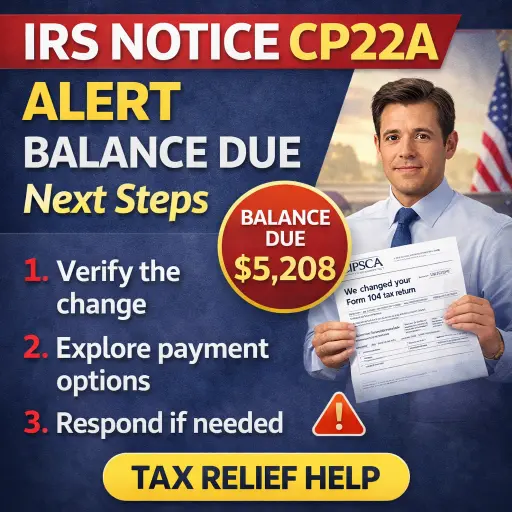
IRS Notice CP22A is the IRS’s way of saying: we changed your tax account for a specific year, and you now owe a balance. The change is tied to an updated version of your tax return information for that year—often because the IRS received new data, corrected something on the return, or processed a change you (or your representative) requested.
Sometimes CP22A follows a stressful situation like underreported income. Other times it comes after a request such as penalty relief—and the notice still shows a balance due because not everything was eliminated. Either way, CP22A is not a “FYI” letter. It’s a balance-due notice that deserves a careful review.
If you’re in Cedar Rapids, Eastern Iowa, or anywhere nationwide, the goal is the same: confirm the IRS is right, then choose the smartest path to resolve the balance.
IRS Notice CP22A At a Glance
| Item | What it means |
|---|---|
| Notice type | Adjustment notice (balance due after a change) |
| Why you received it | The IRS updated your tax liability for a specific year |
| Common causes | Underreported income, corrected credits, penalty/interest changes, IRS processing corrections |
| What happens next | The IRS finalizes the updated balance and continues collection activity if unpaid |
| Recommended action | Verify the change, dispute if incorrect, then pay or set up a resolution option |
IRS Notice CP22A Explained, Part by Part
CP22A notices aren’t identical for every taxpayer. The first page usually reflects the “reason codes” and categories that apply to your situation. Still, most CP22A letters follow a similar structure.
Part 1: Billing summary and reason for the adjustment
The first page is the headline: your account changed and there is a balance due.
You’ll typically see:
- the tax year involved,
- a short explanation of what the IRS adjusted (often by category), and
- a billing summary showing how the balance was calculated.
Common categories you might see referenced include:
- interest/dividend income,
- capital gains or investment activity,
- credits such as the Earned Income Credit,
- penalty or interest recalculations.
A CP22A connected to underreported income often shows:
- an increase in tax,
- possibly a reduction in credits the IRS believes you don’t qualify for after the income change, and
- added penalties and interest based on the revised balance.
A CP22A connected to penalty relief or other favorable adjustments may show decreases in certain charges—but still end with an amount due if a balance remains.
What to do here: Compare the IRS’s explanation to your records (return, schedules, notices, transcripts, and any correspondence you or your CPA submitted).
Part 2: Payment coupon
Many CP22A notices include a detachable payment stub. It usually lists:
- the amount due,
- the “pay by” date (or the date the IRS wants prompt action),
- the tax year/period and identifiers so a payment is credited correctly.
If you mail a payment, the coupon and correct identifying information help reduce misapplied payments.
Part 3: What you need to do now regarding IRS Notice CP22A
This section usually splits into two tracks:
- If you agree: pay the balance using the methods listed on the notice.
- If you disagree: contact the IRS using the notice instructions (often a phone number and guidance on what to have ready).
One important practical point: if you do nothing, the IRS will typically treat the adjustment as accepted and proceed with normal collection steps. That doesn’t mean you have no rights—but it can make things harder later.
Part 4: Payment options if you can’t pay in full
CP22A commonly acknowledges that not everyone can pay the full balance immediately. It may reference options such as:
- an installment agreement,
- a settlement option (Offer in Compromise) when eligible,
- a temporary collection delay due to financial hardship (often associated with currently not collectible status when appropriate).
These are not “automatic approvals.” They depend on filing compliance, financial details, and IRS criteria.
Part 5: Penalty information
If penalties are included, CP22A often provides a summary of what was assessed and what category it falls under.
Depending on the case, you might see accuracy-related penalties (often tied to certain types of understatements) or other penalty categories. The important takeaway isn’t memorizing penalty names—it’s verifying why the IRS assessed them and whether:
- the underlying adjustment is correct, and
- you may qualify for penalty relief based on reasonable cause or administrative relief rules.
Part 6: Interest information
Interest is usually shown or explained because it continues to accrue on unpaid amounts. CP22A may present interest in a table format and include a reminder that the total can change as time passes and payments post.
If the interest figure looks confusing, focus on:
- whether the underlying tax/penalty change is correct, and
- whether the timing of payments and adjustments aligns with your records.
Part 7: Additional information and help resources
Toward the end, CP22A typically includes reminders and resources such as:
- where to learn more about the notice type,
- general IRS contact guidance,
- help resources like the Taxpayer Advocate Service and Low Income Taxpayer Clinics (when applicable),
- a reminder to keep the notice with your records.
When the IRS Sends Notice CP22A
The IRS generally issues CP22A when:
- it updates a prior-year tax account based on new information or a processed change, and
- the result is a balance due.
The “new information” could be:
- third-party income reporting the IRS didn’t match previously,
- IRS corrections during processing,
- changes you requested (such as adjustments or penalty relief) that still leave a balance due.
What You Should Do If You Receive CP22A
Step 1: Read it like an accountant, not like a threat
Start by identifying:
- the tax year involved,
- the specific reasons listed for the adjustment,
- the total balance due and how it’s broken out (tax, penalties, interest).
If you have multiple notices, keep them organized by year. Mixing years is a common source of confusion.
Step 2: Verify the IRS change against your records
This is where many taxpayers either save money—or miss a problem. Compare CP22A to:
- your filed Form 1040 and schedules,
- W-2s, 1099s, brokerage statements, and K-1s (as applicable),
- proof of credits and withholding,
- any letters you sent or changes you requested,
- account transcripts (when available).
IRS systems do make mistakes. But you’ll need documentation to correct them.
Step 3: Decide whether you agree or disagree with your IRS Notice CP22A
- Agree: Pay in full if possible, or move immediately to a payment arrangement if you can’t.
- Disagree: Respond quickly and clearly. Be ready to explain what is wrong (income category, credit, penalty, payment application, timing).
If the issue is technical—especially with investment income, credits, or penalties—CPA review can prevent a “quick call” from turning into months of back-and-forth.
Step 4: Choose a resolution path if you can’t pay in full
If you owe and the adjustment is correct, your next step is selecting the best-fit option:
- installment agreement,
- hardship-based relief when appropriate,
- settlement evaluation when potentially eligible,
- penalty relief request (in the right circumstances).
A key note: many resolution options work best when you’re current on filing. If you have unfiled returns, address those early.
Why Work With a CPA Firm, Not Just a Tax Relief Company
CP22A is often a blend of tax law (what should have been on the return) and IRS accounting (how the IRS posted changes, penalties, and interest). That combination is exactly where CPA-level review adds value.
A CPA firm can help you:
- confirm the adjustment is accurate and supported,
- reconcile penalties and interest to transcripts and timelines,
- prepare a clean dispute response when needed, and
- build a realistic plan to resolve the balance—without sales pressure.
How Corridor Consulting CPAs Can Help With IRS Notice CP22A
Corridor Consulting CPAs helps taxpayers in Cedar Rapids, Eastern Iowa, and across the U.S. with CP22A by:
- reviewing the notice and identifying what changed and why,
- verifying the IRS numbers against your return and supporting documents,
- correcting errors (underreported income disputes, missing credits/withholding, penalty issues),
- pursuing penalty relief when appropriate, and
- setting up a resolution strategy that fits your finances and keeps you compliant moving forward.
We’re a CPA firm—focused on accuracy, documentation, and long-term stability, not quick fixes.
Take the First Step Toward IRS Tax Relief
If CP22A says you owe more than you expected, don’t guess and don’t delay. The best outcome usually comes from a calm review, fast documentation, and a clear plan—either to challenge an incorrect adjustment or to resolve a correct balance in the least painful way.
Corridor Consulting CPAs can help you move from confusion to clarity and take the next step with confidence.
Resources: Learn More About IRS Notices and Your Rights (IRS-only)
- Understanding Your CP22A Notice
- Publication 1 — Your Rights as a Taxpayer
- Taxpayer Bill of Rights
- Installment Agreements — Payment Plans
- Offer in Compromise — Basics
- Penalty Relief — Administrative Relief Options
- Interest — How IRS Interest Works
- Taxpayer Advocate Service — Help with Tax Problems
- Low Income Taxpayer Clinics — Information and Directory
