IRS Notice CP21A is a Notice of Data Processing Adjustment.
It means the IRS has processed changes to one of your tax years – usually based on something you or your representative requested – and, after those changes, you still have a balance due.
Those changes might come from:
- Replacing an IRS-prepared Substitute for Return (SFR) with an original return
- Penalty abatement the IRS has approved
- An amended return you filed
- Other account adjustments (credits applied, amended income, dependency changes, etc.)
So CP21A is not the IRS “coming out of nowhere” – it’s their way of saying:
“We made the changes you asked for. Here’s your updated balance and how we calculated it.”
IRS Notice CP21A at a Glance
- Notice type: Notice of Data Processing Adjustment
- Generated by: IRS Service Center
- Typical trigger: IRS accepts changes to your account (original return replacing SFR, amended return, penalty abatement, etc.)
- What it means: The IRS adjusted your account and you still owe for that year
- Recommended action: Verify accuracy, then pay the balance or enter into a resolution (installment agreement, OIC, CNC, etc.)
IRS Notice CP21A Explained, Part by Part
Part 1: Billing Summary on IRS Notice CP21A
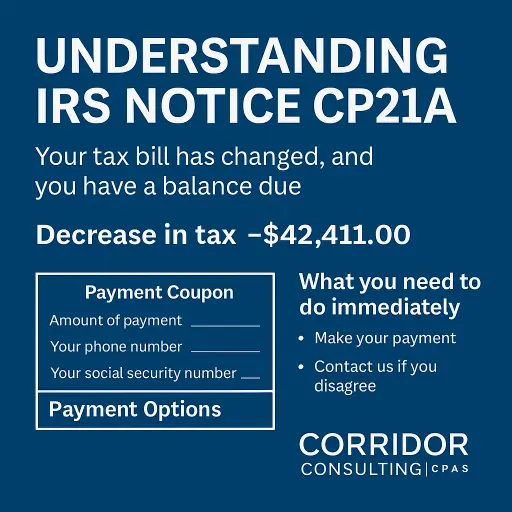
On page one, the CP21A shows how the IRS got from your old balance to your new balance.
You’ll usually see lines like:
- “Account balance before this change”
- This is the amount the IRS showed as due before the adjustment you requested.
- “Decrease in tax” / “Increase in tax”
- This reflects the change from your new information.
- Example: When an original return replaces an SFR and shows less tax due, you’ll see a decrease in tax line reducing the balance.
- Penalty adjustments
- Decrease in failure-to-file penalty – the 5% per month penalty (up to 25%) for filing late.
- Decrease in failure-to-pay penalty – the 0.5% per month penalty (up to 25%) for paying late.
- Decrease in interest
- Interest is computed on the balance (including penalties) and compounds daily. If your balance goes down, some interest comes off too.
At the bottom of this section, you’ll see your updated total amount due for that tax year.
Part 2: Payment Coupon on IRS Notice CP21A
The CP21A includes a payment coupon you can mail back with a check or money order if you want to pay this year’s balance in a lump sum.
If you owe for multiple years, you may receive multiple CP21A notices. It’s sometimes smart to prioritize certain years over others (for example, older years closer to the collection statute expiry or years with liens already filed). The IRS won’t coach you on which years to pay first – that’s a strategy decision.
Part 3: What the IRS Says You Need to Do Immediately With IRS Notice CP21A
Here the IRS divides your options into two paths: you agree or you disagree with the changes.
If you agree with the changes:
- Pay the updated balance in full, or
- Set up some form of tax resolution (installment agreement, offer in compromise, etc.)
If you disagree with the changes:
- The notice gives you a phone number to call.
- You may be asked to send supporting documents (original return, amended return, proof of payments, penalty abatement request, etc.).
If you simply ignore the CP21A, the IRS treats the balance as valid and can eventually move toward liens and levies.
Part 4: Payment Options For IRS Notice CP21A
The CP21A explains the ways you can pay, including:
- Direct pay from a bank account at IRS.gov
- Debit/credit card payments
- Mailed check or money order with the payment coupon
If you can’t pay in full, the notice usually mentions that you may still qualify for:
- An installment agreement – pay over time
- An offer in compromise (OIC) – in some cases, settle for less than the full amount owed
- A temporary collection delay (Currently Not Collectible, CNC) – if paying anything right now would create serious financial hardship
Part 5: Interest Charges For IRS Notice CP21A
Later in the notice you’ll see one or more tables labeled Interest Charges.
They show:
- The period for which interest was calculated
- The interest rate
- The underlying balance that interest was computed on
- The total interest amount for that period
You may notice some interest lines that no longer match the final balance exactly. That’s because:
- The IRS often computes interest before all adjustments are finalized
- Some of those interim interest amounts may ultimately be removed or recomputed once your account is fully updated
If you’re confused, the true number to focus on is the total amount due in the billing summary on page one.
Part 6: Additional Information On IRS Notice CP21A
Near the end, the CP21A usually includes:
- The IRS’s official CP21A webpage
- Links or references for forms and publications
- Contact information for the IRS
- A reminder to keep the notice with your tax records
Why the IRS Sends Notice CP21A
In plain English:
The IRS CP21A tells you: “We accepted the change you requested for this year, updated your account, and you still owe us money.”
This might follow:
- Filing an original return to replace an IRS Substitute for Return
- Filing an amended return
- Requesting penalty abatement or another account adjustment
- IRS corrections based on information returns (W-2s, 1099s, etc.) plus your response
The notice documents that the IRS agreed with (some or all of) your requested changes and shows how those changes affected your balance.
What To Do If You Receive IRS Notice CP21A
Step 1: Check the CP21A for Accuracy
Do not assume the IRS math is perfect.
- Compare the CP21A numbers to:
- The return you filed (original or amended)
- Your penalty abatement request, if any
- Your payment history (checks, Direct Pay, EFTPS, etc.)
Make sure:
- The change description matches what you requested
- The tax, penalty, and interest movements make sense
- Your payments and credits are properly reflected
Step 2: Correct Any IRS Errors
If something looks wrong:
- Use the phone number listed under “What you need to do immediately” to call the IRS
- If your disagreement relates to penalties, the notice often lists a separate number for “detailed penalty calculations”
Be ready to:
- Explain exactly what is wrong
- Provide copies of your return, amended return, correspondence, or proof of payment
- Document dates and amounts, not just “this feels wrong”
If this feels overwhelming or you’re already exhausted from dealing with the IRS, this is the point where a CPA firm like Corridor Consulting can step in and handle the back-and-forth for you.
Step 3: Seek Penalty Abatement Where Appropriate
Even after a CP21A, there may still be penalties on your account.
In many cases, we explore:
- First-time abatement (FTA) if you’ve been compliant in prior years
- Reasonable cause penalty relief (illness, records destroyed, reliance on written IRS advice, etc.)
The IRS doesn’t always grant relief – but in practice, it’s often worth asking. A well-documented penalty abatement request can save thousands of dollars.
Step 4: Pay the Balance or Seek Tax Relief
Once you’re confident the numbers are right (or as corrected as they can be), you still have to deal with the balance.
Your options generally fall into one of four buckets:
- Pay in full
- Fastest way to stop additional interest from accruing and move on.
- Set up an installment agreement
- Spread payments out monthly.
- Different programs exist depending on how much you owe and your financial situation.
- Request Currently Not Collectible (CNC) status
- If paying anything would create severe hardship, the IRS may agree to temporarily pause collection.
- Interest still accrues, and the IRS may revisit your case in the future, but active levy action is stopped while you’re in CNC.
- Pursue an Offer in Compromise (OIC)
- In the right situations, you may be able to settle for less than the full balance.
- The IRS looks at income, expenses, assets, and future earning potential.
- OICs are powerful but technical; a poorly prepared offer can be rejected and waste time.
Do You Need a CPA Firm or a “Tax Relief” Company?
When a CP21A shows a big balance due – especially after you’ve already tried to fix things – the temptation is to call the first “pennies on the dollar” ad you see. But you really need a CPA Firm.
A few things to keep in mind:
- Most national tax-relief shops are sales organizations first.
You may talk to a closer, not the professional actually working your case. - They often charge large non-refundable retainers up front before anyone has truly reviewed your transcripts or return.
- Many still outsource the technical work to local CPAs or enrolled agents.
A CPA firm that actually prepares returns, amends them, and negotiates with the IRS every day is usually better positioned to:
- Verify the CP21A adjustments and fix any remaining issues
- Integrate your CP21A year with other tax years, your business returns, and your future planning
- Design a resolution strategy that isn’t just “lowest payment now,” but actually supports your long-term financial goals
How Corridor Consulting CPAs Helps With IRS Notice CP21A
At Corridor Consulting, we regularly help clients who:
- Had IRS Substitute for Returns replaced by proper returns
- Requested penalty abatements and received CP21A notices showing updated balances
- Are overwhelmed by multiple years of notices and shifting balances
When you bring us a CP21A, we typically:
- Pull IRS transcripts to verify exactly what changed.
- Reconcile those changes with your filed returns or amendments.
- Identify remaining opportunities for penalty relief or corrections.
- Build a tailored resolution plan – pay in full, installment agreement, CNC, or Offer in Compromise – aligned with your actual finances.
- Help you avoid repeat issues by tightening up future filing, estimates, and entity structure where needed.
Next Step If You’re Holding a CP21A Right Now
If you’ve just opened IRS Notice CP21A and you’re not sure whether the numbers are right – or what to do with the balance – you don’t have to figure it out alone.
You can:
- Schedule a Discovery Chat with Corridor Consulting CPAs to walk through your options.
Getting clarity on a CP21A isn’t just about this year’s balance – it’s about making sure the IRS’s changes are correct and that your next move protects your cash flow, your peace of mind, and your long-term plans.
Additional IRS Resources
- IRS – Understanding Your CP21A Notice
Official IRS page explaining why CP21 series notices are issued and what your options are. - IRS – View Your Account Information Online
Secure online access to your balance, payment history, and transcripts so you can confirm the numbers on your CP21A. - IRS – Make a Payment
Pay your balance in full or partial using Direct Pay, debit/credit card, or other electronic options. - IRS – Payment Plans, Installment Agreements
Details on setting up a monthly payment plan if you can’t pay the full amount at once. - IRS – Offer in Compromise
Official guidance on settling your tax debt for less than you owe, including links to Form 656 and the pre-qualifier tool. - IRS – Penalties: Abatement and Relief
Overview of reasonable cause, first-time penalty abatement, and how to request penalty relief.
