If you’re out there trying to figure out how to choose an accounting firm, I want to warn you about something most people never realize:
A lot of the “credibility signals” you see online—the badges, the stars, the awards, the “As Seen in Forbes” logos—are not what you think they are.
Many of them are paid for.
Not earned.
Not vetted.
Not independently verified.
Paid for.
And if you don’t know that, you can very easily end up trusting the wrong firm.
Let’s be honest about how this industry actually works, so you can make better decisions with your money and your business.
How to Choose an Accounting Firm When Online Reputation Is Rigged
Most business owners assume that choosing an accounting firm is as simple as:
- If a firm has great reviews, they must be good.
- If they’re “accredited” somewhere, they must be trustworthy.
- If they’ve got big logos (Forbes, Inc., etc.) on their site, they must be legit experts.
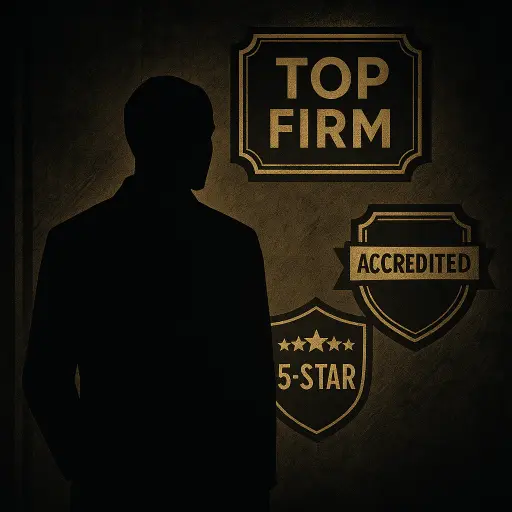
- If they have “Top Firm” awards, they must be the best in town.
I wish that were true.
But in reality, a lot of firms have simply learned how to game the system, buy prestige, and hide criticism.
If you really want to know how to choose an accounting firm you can trust, you have to look past the surface-level signals and understand what’s actually going on.
Let’s walk through a few of the biggest traps.
1. How to Choose an Accounting Firm When You See the BBB Badge
The Better Business Bureau sounds official, neutral, and trustworthy. Most people assume:
“If they’re BBB accredited with a good rating, they must take care of their clients.”
What they don’t realize is that accreditation is paid. Firms pay an annual fee to be “accredited.” That’s not a secret—it’s just not obvious to the average person who’s trying to quickly choose a CPA firm and move on with their life.
On top of that, there are ways firms can “manage” complaints and reviews:
- They can push disputes into the BBB internal process.
- They can respond and negotiate to get issues “resolved.”
- The public-facing picture can end up a lot cleaner than the reality.
Does that mean every BBB-accredited business is shady? No.
But it does mean:
- A BBB badge = they pay the fee.
- A good BBB profile ≠ full, raw, unfiltered reality.
So if you’re wondering how to choose an accounting firm and you see that logo and think, “Well, that settles it, they’re safe,” you’re giving that badge way more weight than it deserves.
2. How to Choose an Accounting Firm When They’re “As Seen in Forbes”
Another big one: the Forbes logo.
You’ll see firms proudly say:
- “Featured in Forbes”
- “Forbes Author”
- “As Seen on Forbes”
It sounds like a journalist discovered them, vetted them, and chose to highlight their work.
In a lot of cases, that’s not what happened.
What actually happens often looks more like this:
- The firm (or someone on their behalf) pays a media group or membership fee.
- That fee gives them access to post articles on a big-name platform.
- The articles are essentially self-promotional: “top 7 tax strategies,” “why you need a strategic advisor,” etc.—with their firm conveniently positioned as the solution.
- Then they take the logo, slap it on their website, and suddenly it looks like a prestigious editorial endorsement.
What you see:
“Wow, they write for Forbes. They must be highly respected in the industry.”
What’s often true:
“They pay an annual fee to be able to post content on a platform that carries the Forbes brand.”
Is every Forbes appearance paid? No.
Is a lot of “Forbes contributor”–style content pay-to-play? Yes.
And most clients have no idea there’s a difference.
If you’re serious about how to choose an accounting firm wisely, you can’t treat every big media logo as proof of expertise.
3. How to Choose an Accounting Firm When Awards Can Be Bought (Yes, Really)
You’ve probably seen variations of:
- “Top 10 Accounting Firm in [City]”
- “Best Tax Advisor of 2024”
- “Award-Winning CPA Firm”
- “Top Financial Professional in [Region]”
Sounds nice. Feels reassuring. But many of these awards are:
- Self-nominated
- Paid for (sponsorship, listing fees, “winner’s package” fees)
- Based on who pays or participates—not on actual performance or client outcomes
Some of these “award” companies make their money by:
- Charging firms to be listed
- Charging extra to be “featured”
- Selling the badge/logo rights
So the public sees a gold seal and thinks:
“Wow, they won something special.”
When in reality, the firm may have just filled out a form and paid a fee.
Again: not all awards are fake or useless. But when you’re figuring out how to choose an accounting firm you can trust, you need to understand that a lot of these shiny badges are just marketing products.
4. How to Choose an Accounting Firm When the Reviews Look Too Perfect
Since we’re talking about credibility, we can’t ignore this part: some of what firms are doing with reviews isn’t just slimy, it’s very likely on the wrong side of the FTC.
The short version:
You’re not allowed to manufacture a perfect reputation and pretend it’s organic.
1. Fake reviews aren’t just gross, they’re risky
The FTC is cracking down on:
- Reviews from people who never used the service
- Completely made-up “customers”
- Testimonials that twist what actually happened
Buying or arranging reviews you know are fake—or should know are fake—isn’t “smart marketing.” It’s deceptive. That wall of suspiciously similar 5-star reviews from people with no detail? That’s exactly the kind of thing regulators are looking at.
2. You can’t only pay for praise
Incentivising reviews is another area they care about.
What you can’t do is:
“Leave us a 5-star review and get a gift card.”
If you offer something in return for a review, it has to be for honest feedback, not “only say nice things about us.” Otherwise, you’re rigging the system—and the FTC sees that as misleading.
3. The big one: only showing 5-star reviews
This is where a lot of firms quietly cross the line.
The FTC has made it clear that businesses can’t:
- Hide or bury negative reviews just because they’re negative
- Showcase only the glowing reviews and pretend that’s the full picture
That kind of selective “review curation” is treated as deceptive.
Now, to be fair, companies are allowed to remove reviews that break basic rules—stuff like threats, hate speech, doxxing, or spam. But those rules have to apply equally to positive and negative reviews.
What you can’t do is use “policy” as an excuse to scrub anything that makes you look bad.
So yes, your gut is right:
If a firm is proudly displaying nothing but 5-star praise, no nuance, no mixed experiences, and acting like that’s representative of all their feedback? That’s exactly the type of behavior the FTC is paying attention to.
4. You can’t muzzle people, either
There’s also a separate law that basically says: you don’t get to silence people for telling the truth.
Businesses can’t hide clauses in their contracts that punish customers for leaving honest negative reviews. No fines, no threats, no “we’ll sue you if you say anything bad about us” nonsense—at least not legally.
So when you see a firm with:
- Zero negative reviews
- No lukewarm, “it was okay but…” experiences
- Just endless perfection
…it’s not paranoid to be suspicious. It’s smart.
Why This Matters When You’re Figuring Out How to Choose an Accounting Firm
You might be thinking:
“Okay, so some of this stuff is paid marketing. Isn’t that just how the world works?”
The reason this matters—and the reason I’m even writing this—is because of what’s at stake when you choose a CPA firm.
You’re not choosing a t-shirt brand.
You’re choosing someone to:
- Touch your books
- See your personal financial mess
- Help you with the IRS
- Guide your tax planning
- Influence your long-term wealth and stress
If you choose based on smoke and mirrors:
- You can end up with a firm that looks polished online but is chaotic behind the scenes.
- You can get surface-level compliance instead of real strategy.
- You can miss huge opportunities—or step into avoidable problems—because you trusted the wrong signals.
Meanwhile, there are firms doing incredible work, changing lives and businesses, but they don’t buy awards or pay for glossy badges. So they get buried under the noise.
That’s the part that really frustrates me.
How to Choose an Accounting Firm: What to Look For Instead
If you can’t fully trust badges, awards, or fancy logos, what should you look at instead when deciding how to choose an accounting firm?
Here are things that are much harder to fake:
1. Real client stories with specifics
Look for details like:
- “They helped us clean up three years of messy books.”
- “We went from never knowing our cash position to having monthly clarity.”
- “They helped us avoid/resolve IRS issues worth $X.”
If all the testimonials are generic—“They’re great!” “Super friendly!”—and there’s no detail, that’s a red flag.
2. A clear process, not just pretty branding
A real firm with real systems will be able to explain:
- How they onboard you
- What happens in the first 30–90 days
- How often you’ll hear from them
- What they deliver and when
You should see structure, not just marketing language. If a firm can’t walk you through their process, that tells you a lot.
3. Straight talk about your actual situation
On a discovery call, pay attention:
- Are they asking detailed questions?
- Are they trying to understand your goals, fears, and current systems?
- Are they willing to tell you what won’t work for you?
Or are they just pushing you into a package as quickly as possible?
A firm that’s serious about long-term partnership will slow down enough to understand you before quoting anything.
4. Unfiltered reviews in places they can’t fully control
No platform is perfect, but look at:
- Google reviews
- Longer-form online comments or posts where clients share stories
- Referrals from people you actually know
You’re looking for patterns and specifics—not just one or two extreme opinions.
5. How they talk about responsibility (yours and theirs)
A good firm will talk about:
- Your responsibilities as the client
- Their responsibilities as your advisor
- Boundaries, deliverables, deadlines
- What they need from you to do good work
Bad firms over-promise and downplay the work involved. Good firms are honest about the fact that clarity is a partnership.
So, Here’s How to Choose an Accounting Firm (In Plain English)
If we boil all this down, here’s a simple way to approach how to choose an accounting firm:
- Ignore the noise.
Treat badges, awards, and logos as neutral—not as proof of competence. - Ask about their process.
“What happens in the first 30, 60, and 90 days if we work together?” - Ask for real examples.
“Can you walk me through a client situation similar to mine and what changed for them?” - Look for honesty, not hype.
Pay attention to whether they’re willing to tell you “no,” or “that’s not realistic.” - Notice how you feel.
Do you feel rushed and sold to, or understood and advised?
If You’re Tired of the Show…
The whole reason I wanted to write this is simple:
I don’t want you to be intimidated or misled by the show.
You don’t need:
- Twenty badges
- A Forbes logo
- A wall of purchased awards
What you need is:
- Someone who will tell you the truth
- A team that actually does the work well
- A process that gives you clarity and control, not more confusion
If you’re at the point where you know you need better support—and you don’t want to fall for fake credibility—your next step is simple:
Have one honest conversation with a firm and make them walk you through their process, not their trophies.
If they can’t do that clearly, that tells you everything you need to know.
Further Resources (If You Want to Dig Deeper)
If you want to go beyond my opinion and see what official bodies and regulators say, here are some solid places to start:
IRS – Choosing a Tax Professional
A straightforward guide on different types of tax pros (CPAs, EAs, attorneys) and what to consider before you hand over your information. Good baseline reading if you’re trying to choose someone qualified, not just someone with a flashy website.
IRS – Choosing a Reputable Tax Preparer Is Vital to Tax Security
This one focuses more on security and fraud. It’s a reminder that you’re not just choosing “someone to do your taxes”—you’re trusting someone with very sensitive data.
The main professional body for CPAs in the U.S. explains what to ask, what to expect, and how to evaluate a CPA beyond surface-level marketing.
AICPA – Five Ways Small Businesses Can Choose the Right Accounting Firm
Specifically geared toward small business owners. Helpful if you’re trying to compare firms and don’t quite know where to start or what questions to ask.
Better Business Bureau – Get Accredited
This is the BBB’s own page explaining how businesses become accredited. It’s useful to look at if you’ve always assumed BBB accreditation was purely “earned” instead of being part of a paid relationship.
Better Business Bureau – Eligibility Requirements for Accreditation
Details the standards a business is supposed to meet to be accredited. Worth skimming so you understand what that little BBB badge actually does—and does not—mean.
Forbes Councils – Visibility / Publishing on Forbes.com
This page describes how paying members get “visibility” on Forbes.com, including the ability to publish articles. It’s a good behind-the-scenes look at why “As Seen in Forbes” doesn’t always mean what people think it means.
FTC – Endorsements, Influencers, and Reviews
The Federal Trade Commission’s guidance about endorsements and reviews—what’s allowed, what has to be disclosed, and where businesses get in trouble. Helpful context when you’re thinking about “too-perfect” testimonials and curated review pages.
FTC – Consumer Reviews and Testimonials Rule (Q&A)
More detailed Q&A on how the FTC views fake, suppressed, or manipulated reviews. This is the kind of thing regulators use when they go after companies for dishonest review practices.
FTC – Updated Endorsement Guides: Combat Deceptive Reviews & Endorsements
Press release summarizing how the FTC is updating its rules to deal with deceptive reviews and endorsements. If you want to see how serious this topic is, this is a good snapshot.
