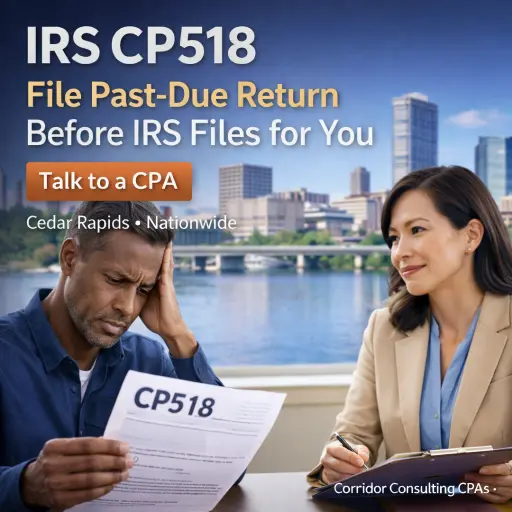
IRS Notice CP518 is a final IRS reminder that they believe you still haven’t filed a required tax return for a specific year. It’s not a standard bill—it’s a compliance notice telling you to file (or clearly explain why you don’t have to).
Most CP518 cases are fixable. The key is responding the right way for your situation: file the missing return, prove you already filed it, or explain why you weren’t required to file.
If you’re in Cedar Rapids or Eastern Iowa (or you’re elsewhere and want a CPA firm that works with taxpayers nationwide), CP518 is a notice where a calm, organized response can prevent the problem from escalating.
IRS Notice CP518 At a Glance
- Notice type: Return delinquency (missing return)
- Generated by: IRS Individual Master File (IMF) systems (commonly shown on the notice)
- Often preceded by: CP59 or CP516
- Often followed by: LT26
- Recommended action: File the required tax return, or respond that you already filed or don’t have a filing requirement
- Form commonly included/referenced: Form 15103 (Return Delinquency)
IRS Notice CP518 Explained, Section by Section
IRS Notice CP518 Section 1: “You must file your tax return”
This is the headline message. The IRS is stating they don’t have the return for the tax year listed. If more than one year is unfiled, you may receive separate notices for different years.
IRS Notice CP518 Section 2: “What you need to do immediately”
The IRS typically asks you to do one of the following right away:
- File the missing return, or
- Tell the IRS why you’re not required to file, or
- Confirm you already filed and provide details.
This section often includes practical reminders, like signing a mailed return and including an Identity Protection PIN (IP PIN) if you’ve been issued one.
IRS Notice CP518 Section 3: “If we don’t hear from you”
This section explains what may happen if you don’t respond. Common outcomes the IRS warns about include:
- Substitute for Return (SFR): The IRS may prepare a return for you based on income information they have. An SFR typically does not include deductions and credits you might legitimately qualify for.
- Potential loss of refund: If you’re due a refund for that year, waiting too long can mean you miss the deadline to claim it.
- Refund delays for other years: When filing compliance is incomplete, it can slow down processing for other refunds or account actions.
IRS Notice CP518 Section 4: “Payment options”
CP518 is primarily about filing, but the notice generally acknowledges that if filing results in a balance due, you may have options beyond paying in full immediately. The IRS often references options like payment plans and other arrangements depending on your circumstances.
IRS Notice CP518 Section 5: “About your return”
This is usually a short explanation that the IRS received information suggesting you had enough income (or other tax items) to require filing for the year listed.
IRS Notice CP518 Section 6: “Income reported by others”
Here the IRS explains that third parties reported income under your name and SSN/TIN—such as wages, interest, or other common information documents. CP518 may also note that you can review what was reported by checking your wage and income transcript.
IRS Notice CP518 Section 7: “Additional information”
This section generally contains helpful administrative items, which may include:
- How to get forms and publications
- How to contact the IRS
- Taxpayer rights information
- Taxpayer Advocate Service and Low-Income Taxpayer Clinic references
- General reminders about the IRS contacting third parties in certain situations
IRS Notice CP518 Section 8: “Stub” (reply portion)
Many CP518 notices include a detachable stub or response component, often used if you’re returning Form 15103 or corresponding by mail.
When the IRS Sends Notice CP518
The IRS typically sends CP518 after earlier “we haven’t received your return” notices (often CP59 or CP516) and the IRS still doesn’t show the return as filed. CP518 is essentially the IRS saying: “This is your final reminder before we move forward.”
If you recently filed the return, CP518 can also be a timing issue—IRS processing delays can cause notices to cross in the mail.
What You Should Do If You Receive CP518
Step 1: Verify the year and whether you truly missed a filing
Confirm:
- The tax year listed
- Your identifying information
- Whether you filed that year (and how you filed it)
If you did file, locate proof: certified mail receipt, tracking, an e-file acceptance record, or a copy of the filed return.
Step 2: Pick the correct response path
Most taxpayers fall into one of these scenarios:
- You didn’t file: File the original return as soon as you can.
- You already filed: Respond with the details and keep proof of submission.
- You don’t have a filing requirement: Respond with an explanation and supporting facts.
Step 3: Use Form 15103 when it fits (and document everything)
If your CP518 package includes Form 15103 (or the notice instructs you to use it), it can be a clean way to communicate:
- “I already filed,”
- “I’m filing now,” or
- “I’m not required to file,” with your reasoning.
Whatever you send, keep copies and proof of delivery.
Step 4: Plan for what happens after the return posts
Once your return is filed and processed:
- You may be due a refund or have minimal balance, or
- You may owe a balance due (tax plus potential penalties and interest)
If you owe and can’t pay in full, that’s when it makes sense to talk through payment options and, where appropriate, penalty relief or other resolution strategies.
Why Work With a CPA Firm, Not Just a Tax Relief Company
CP518 is a filing compliance problem first. The fastest and safest solution is usually getting the right return filed correctly—especially if the year is older or records are incomplete.
A CPA firm can help you:
- Confirm whether you actually had a filing requirement
- Rebuild income and deduction records the right way
- File in a manner that protects legitimate deductions and credits
- Create a practical plan if filing results in a balance due
That’s different from high-pressure “settlement” sales. The goal is to get you compliant and keep you there.
How Corridor Consulting CPAs Can Help With IRS Notice CP518
When you bring us a CP518, we focus on clarity and progress:
- Identifying exactly which year(s) are missing
- Helping you prepare and file delinquent returns accurately
- Responding properly if you already filed or don’t have a filing requirement
- Developing a plan if filing creates a balance you can’t pay immediately
- Building long-term compliance so the IRS doesn’t keep sending notices
We’re a Cedar Rapids CPA firm that supports both urgent IRS notice work and ongoing tax/accounting needs.
Take the First Step Toward IRS Tax Relief
If you received IRS Notice CP518, don’t ignore it. The IRS is asking for one of two things: a filed return or a clear explanation.
Corridor Consulting CPAs can help you respond confidently, get compliant, and map out the next step—whether you’re in Eastern Iowa or anywhere in the U.S.
