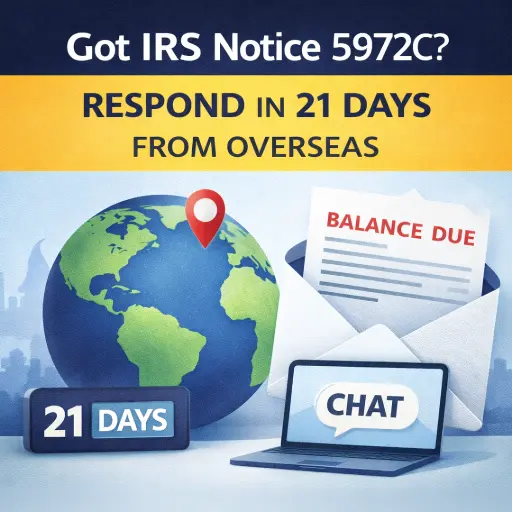
IRS Notice (Letter) 5972C is an IRS balance-due reminder that often goes to taxpayers living outside the United States. It says you still owe for the tax year(s) listed and asks you to respond promptly—typically within 21 calendar days of the letter date.
What makes 5972C different from many other IRS balance-due letters is how the IRS wants you to respond. The IRS built a dedicated page for this letter that pushes an online chat option (“Chat Now”) as a primary way to contact them.
If you’re overseas and worried you’ll miss a deadline or can’t reach the IRS easily, don’t panic. This letter is often the IRS trying to get you into a payment arrangement or get the account moving—before things escalate.
IRS Notice 5972C At a Glance
- Letter purpose: Reminder that a balance is due for the tax year(s) shown
- Common audience: Frequently associated with international taxpayers (especially when the notice emphasizes overseas contact methods)
- Response timing: The letter commonly asks to hear from you within 21 days
- What to do: Pay in full, set up a resolution option, or dispute the balance if it’s wrong
How to Read IRS Notice 5972C Section by Section
1) Taxpayer details and account recap on IRS Notice 5972C
Near the top, you’ll see identifying information and the tax year(s) and form(s) involved. Then the letter states you have an unpaid balance and shows an account summary breaking out tax, penalties/interest, and the total due.
2) The “we need to hear from you” message on IRS Notice 5972C
The letter asks the IRS to hear from you within 21 calendar days. It also mentions possible enforcement action if the balance isn’t addressed—usually meaning the account may continue through the IRS collection process over time.
3) The “what to do if you already paid” note on IRS Notice 5972C
Many versions include an important line: if you paid in full within the past 14 days or made payment arrangements recently, you may be able to disregard the letter because it can cross in the mail before payments post.
4) Payment paths the IRS lists on IRS Notice 5972C
The letter outlines payment choices, including paying electronically and exploring alternatives if you can’t pay in full. It commonly references options like a payment plan, an offer in compromise, or a temporary collection delay (often called hardship/CNC in day-to-day conversation).
For taxpayers outside the U.S., the letter may specifically mention submitting a payment plan request using Form 9465 and, when applicable, an updated financial statement like Form 433-F.
5) “If we don’t hear from you” on IRS Notice 5972C
This section generally lists the kinds of collection actions that can occur if the balance stays unresolved—such as a federal tax lien filing, levy/seizure actions after required notices, and applying future refunds to the debt.
6) Penalties and interest (general explanations) on IRS Notice 5972C
Later pages often include plain-language explanations of:
- Failure-to-file and failure-to-pay penalty basics (including how they interact)
- Interest and how it accrues while a balance remains unpaid (the letter provides general guidance rather than a custom interest schedule)
7) How the IRS expects you to contact them about IRS Notice 5972C
The IRS’s 5972C guidance emphasizes a chat option and provides contact guidance for taxpayers outside the U.S. (including international phone help lines and any listed chat availability details).
When the IRS Sends Notice 5972C
The IRS sends Letter 5972C when there’s a balance due on a tax account and the IRS is trying to prompt a response through the Automated Collection System (ACS), including the online chat pathway.
In practice, it often shows up when taxes are unpaid, filings are incomplete, or the IRS has assessed a balance and hasn’t received a workable plan yet.
What You Should Do If You Receive IRS Notice 5972C
Step 1: Confirm what year and form the IRS is talking about
Start with the account summary and make sure the tax year(s) and form(s) match your records. If you’ve moved abroad, also consider whether IRS mail might be reaching an old address.
Step 2: Check whether the notice crossed with a recent payment
If you paid recently or set up an arrangement in the last couple of weeks, the letter may simply be lagging behind IRS posting. The notice itself often highlights this “recent payment/arrangement” timing issue.
Step 3: Decide which lane you’re in: disagree, pay, or resolve
Most taxpayers fall into one of these buckets:
- Disagree with the balance: Gather proof (return copies, payment confirmations, transcripts if available) and contact the IRS to correct the record.
- Can pay in full: Paying stops future penalty and interest growth (though it won’t erase what already accrued).
- Need a plan: Prepare for an installment agreement or another resolution path. For international taxpayers, be ready for extra steps and documentation.
Step 4: Respond within the timeline—especially if the balance is large
The letter commonly requests a response within 21 days. Even if your final solution takes longer to set up, starting the conversation early helps reduce the chance of avoidable escalation.
Why Work With a CPA Firm, Not Just a Tax Relief Company
International IRS letters create extra friction: time zones, mail delays, overseas banking limits, and difficulty reaching the right IRS channel.
A CPA firm can help you:
- Reconcile the IRS balance to what’s actually true
- Assemble the financial documentation the IRS may request (without oversharing)
- Build a sustainable plan that keeps you compliant going forward
Corridor Consulting CPAs is a licensed CPA firm—so the help is grounded in real tax work, not a call-center sales script.
How Corridor Consulting CPAs Can Help With Notice 5972C
For taxpayers in Cedar Rapids, Eastern Iowa, and nationwide (including U.S. citizens living abroad), we can help you:
- Review the notice and verify the IRS account details
- Identify whether this is a recent-payment timing issue or a true unresolved balance
- Advise on the best resolution route and handle communications appropriately
- Create a long-term compliance plan so the problem doesn’t repeat next year
Take the First Step Toward IRS Tax Relief
Notice 5972C is a prompt to act—not a reason to spiral. The right next move is to verify the numbers, pick the right resolution lane, and respond within the letter’s timeframe.
If you want steady, professional tax relief help from a Cedar Rapids CPA team, Corridor Consulting CPAs is here to help you move forward with clarity.
