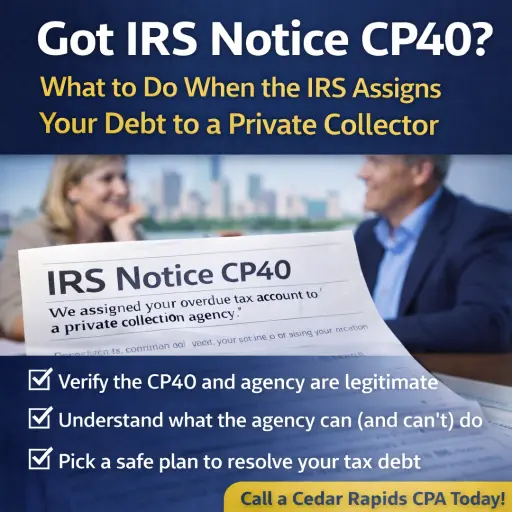
IRS Notice CP40 is the IRS letter that tells you your overdue tax account has been assigned to a private collection agency (PCA) that works under contract with the IRS.
If you’re worried about scams or concerned a private company can start levying your wages, take a breath. CP40 includes specific verification steps, and private collection agencies do not have the same enforcement powers the IRS has.
Below is a clear breakdown of CP40 and a practical plan for what to do next.
IRS Notice CP40 At a Glance
- Notice type: Account assignment to a private collection agency
- What it means: A contracted private agency may contact you to help resolve an overdue IRS balance
- Key safety feature: The notice includes information to help verify you’re speaking with the correct agency
- Bottom line: You still pay the IRS—not the private collection agency
- Recommended action: Verify legitimacy, confirm the balance is correct, then decide whether to pay, set up a plan, or request the account return to the IRS
IRS Notice CP40 Explained, Part by Part
Part 1: The assignment statement
At the top of CP40, the IRS states that your overdue account was assigned to a private collection agency and identifies which agency it is.
Part 2: Why you’re getting CP40
The IRS explains that certain overdue accounts are required to be handled through its private debt collection program and that your account has been placed into that process.
Part 3: What the IRS says you can do
The notice generally emphasizes two ideas:
- Work with the private collection agency to address the balance
- Pay the balance (or as much as possible) using IRS-approved payment methods
It’s important to know you may still have additional resolution options depending on your situation—but you may need to ask for the account to be handled directly by the IRS to explore certain programs.
Part 4: How to protect yourself from scams
CP40 typically describes how the private collection agency will confirm your identity before discussing details and what the IRS will never ask for as payment.
If anyone demands payment via gift card, prepaid card, wire transfer, or unusual payment methods, treat that as a major warning sign.
Part 5: Payment instructions (and who you pay)
Even though a private agency may contact you, payments are made to the IRS through official payment channels. If you pay by check or money order, it should be payable to the United States Treasury and include identifying information.
Part 6: Taxpayer rights and help resources
CP40 typically references taxpayer rights and explains that you can seek help from independent tax professionals. It may also mention resources such as the Taxpayer Advocate Service and Low-Income Taxpayer Clinics for qualifying taxpayers.
When the IRS Sends Notice CP40
CP40 is usually sent before you receive the first outreach from the private collection agency. It’s essentially the IRS’s “heads-up” letter that your account is now being worked through the private debt collection program.
What You Should Do If You Receive CP40
Step 1: Verify the notice and the agency before you share information
Use the contact information on the CP40 itself. Don’t trust phone numbers left in voicemails or texts. If you’re unsure, you can call the IRS using an official number to confirm the assignment.
Step 2: Confirm the balance is accurate
Mistakes happen—payments can be misapplied, returns can be processed late, and balances can be misunderstood. Compare the amount shown on CP40 (and your IRS account records) to your own documents.
If you believe the balance is wrong, gather proof such as payment confirmations, canceled checks, and copies of filed returns.
Step 3: Decide whether to work with the PCA or request the account go back to the IRS
You generally have two broad paths:
- Work with the PCA to discuss payment options and get clarity on what the IRS says is owed
- Request the account be returned to the IRS if you want to deal directly with the IRS or pursue a more structured resolution approach
The right choice depends on your goals, whether you’re disputing the balance, and what type of tax relief you may qualify for.
Step 4: Choose a resolution strategy that fits your finances
Once you confirm the balance is legitimate, you can decide how to resolve it:
- Pay in full if you can
- Set up a payment plan when you need time
- Explore hardship-based options if you truly cannot pay right now
- Consider settlement options in limited cases where the facts support them
The goal is not just to “get through the call.” It’s to pick an option you can actually maintain.
Why Work With a CPA Firm, Not Just a Tax Relief Company
CP40 is where many taxpayers get pressured, confused, or targeted by scams. A CPA firm helps you keep control of the process by:
- Confirming what’s real and what’s not
- Reconciling your actual balance and payments
- Communicating and documenting properly
- Building a plan that keeps you compliant going forward
Corridor Consulting CPAs is a licensed CPA firm, which means you get practical tax expertise and long-term support—not a high-pressure sales experience.
How Corridor Consulting CPAs Can Help With CP40
For taxpayers in Cedar Rapids, Eastern Iowa, and nationwide, we can help you:
- Review the CP40 and confirm the private collection assignment is legitimate
- Reconcile the IRS balance with your records and payment history
- Advise whether it makes sense to work with the PCA or request IRS handling
- Map out a realistic resolution plan and help prevent future IRS issues
Take the First Step Toward IRS Tax Relief
If you received IRS Notice CP40, you don’t have to handle private collection outreach alone. The right approach is to verify the facts, protect yourself from scams, and choose the smartest next step for your situation.
If you want calm, practical tax relief help from a Cedar Rapids CPA team, Corridor Consulting CPAs is ready to help.
