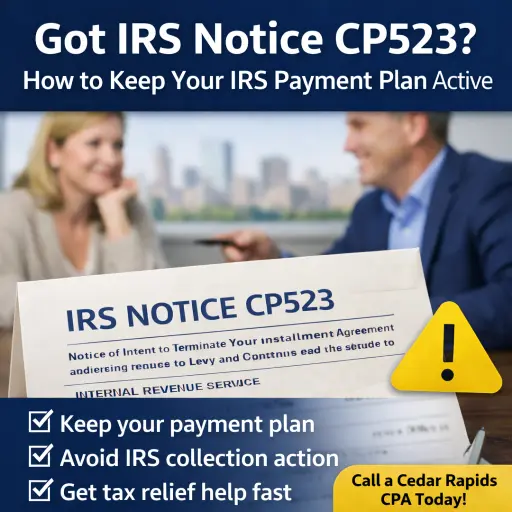
IRS Notice CP523 is the letter the IRS sends when it believes you broke one or more terms of your installment agreement (payment plan). It’s essentially a warning that the IRS may terminate your plan if you don’t fix the issue within the deadline shown on the notice (often 30 days).
That sounds scary, but many CP523 situations are recoverable—especially when you respond quickly, document what happened, and get back into compliance.
IRS Notice CP523 At a Glance
- Notice type: Installment agreement default notice with intent to terminate the agreement
- Why it’s sent: The IRS believes your payment plan is in default (for example, missed payments or new unpaid taxes)
- Typical deadline: Often 30 days from the notice date to cure the default and avoid termination
- What may happen next: The IRS can end the agreement and resume collections activity
- Recommended action: Verify the default reason, cure it if possible, and if not, request a modification or consider an appeal
IRS Notice CP523 Explained, Part by Part
1) Default reason and account summary on IRS Notice CP523
On the first page, the IRS explains why it believes your installment agreement is in default. On the same page (often to the right), it provides a breakdown of what it says you owe for that specific tax year or period, including tax, penalties, and interest.
2) Payment coupon on IRS Notice CP523
Most CP523 notices include a payment stub at the bottom of page one. If you plan to pay by mail, you’d send that with your payment. Even if you pay another way, the coupon signals the IRS is expecting action right away.
3) The “intent to levy” language on IRS Notice CP523
CP523 generally includes language explaining that it is a notice of intent to levy. In plain English, a levy is the IRS taking money from assets or income streams (such as wages or bank accounts) to satisfy unpaid taxes after required notices are issued.
4) What the IRS wants you to do with IRS Notice CP523
This part usually outlines your main options:
- Fix the default by paying the past-due amount or catching up on missed payments
- Provide updated financial information if you can’t pay and need the IRS to consider revising the agreement (this often involves an updated financial statement)
- Dispute the issue if you believe the IRS is wrong about the default or the amount due
- Consider an appeal if you’re not getting traction and you believe termination is inappropriate
5) How this relates to broader collection action
CP523 is serious because once the installment agreement is terminated (and any applicable appeal rights are addressed), the IRS can move forward with collection steps. In some cases, the IRS’s levy authority is broader if it has already provided certain due process notices for that tax period.
6) Passport-related warning section
Many CP523 notices include a section discussing passport restrictions tied to “seriously delinquent tax debt.” That’s a separate process with specific requirements and inflation-adjusted thresholds. Not everyone who gets CP523 is at risk of passport issues—but the IRS includes this information to explain one potential consequence for qualifying cases.
7) Payment options and what happens if you don’t respond
The notice typically explains ways to pay and warns that if you don’t act within the deadline, the IRS can terminate the installment agreement and may pursue additional collections steps, including potential lien filing.
8) Extra information and taxpayer assistance
Toward the end, CP523 often includes general items like where to find forms and publications, how to contact the IRS, and references to taxpayer assistance resources.
9) Penalties and interest breakdown
Most versions include sections explaining penalties assessed and interest charged, along with how they’re calculated. Interest generally accrues over time, so delays can make the balance grow.
When the IRS Sends Notice CP523
The IRS commonly issues CP523 when it believes one of these happened:
- You missed one or more monthly payments under the agreement
- You incurred new federal tax debt after the agreement started and didn’t pay it
- The IRS requested updated financial information and did not receive it
- You fell out of compliance on current filing or payment obligations
A key point: CP523 can still be issued even if you already “fixed” something—because the IRS may not have posted the payment or processed the return yet. That’s why confirming account activity matters.
What You Should Do If You Receive CP523
Step 1: Confirm whether the IRS is correct about the default
Start by identifying the reason listed on page one. Then compare it to your records:
- Was the payment actually missed (or did it process late)?
- Did you file a new return with a balance due that wasn’t paid?
- Did the IRS ask for financial information that you didn’t send?
If the IRS is wrong, you’ll want proof ready (payment confirmations, bank records, copies of correspondence, and filing records).
Step 2: Cure the default quickly if you can
If you can pay what’s needed to bring the agreement current, do it as soon as possible. Many taxpayers can reinstate their plan simply by catching up on a missed payment or addressing a new balance promptly.
Step 3: If you can’t cure it, request a restructure or alternative plan
If you can’t pay the amount required to cure the default, contact the IRS and be prepared to provide updated financial information so it can evaluate:
- A revised installment agreement payment amount
- Rolling a new balance into the agreement (when allowed)
- Other collection alternatives based on ability to pay
This is where having your financials organized matters. A sloppy or incomplete financial submission can lead to delays, denials, or terms you can’t realistically maintain.
Step 4: Consider an appeal if you’re stuck
If the IRS is moving toward termination and you disagree with the decision—or you’re being denied a workable solution—an appeal may be appropriate. Appeals are time-sensitive, so this is not a “wait and see” situation.
Why Work With a CPA Firm, Not Just a Tax Relief Company
A CP523 isn’t only about “making it go away.” It’s about keeping your case stable:
- Making sure payments are credited correctly
- Fixing compliance gaps that caused the default in the first place
- Presenting financial information accurately and defensibly
- Building a plan you can actually maintain month after month
Corridor Consulting CPAs is a licensed CPA firm, which means you get technical tax expertise, transparent guidance, and support that extends beyond a single notice—especially helpful for small business owners and self-employed taxpayers.
How Corridor Consulting CPAs Can Help With CP523
For taxpayers in Cedar Rapids, Eastern Iowa, and nationwide, we can help by:
- Reviewing your CP523 and identifying the true default trigger
- Verifying postings and balances so you’re not chasing the wrong number
- Preparing updated financial information for modification requests
- Advising on next-step resolution strategies when payment in full isn’t realistic
- Helping you build a long-term compliance plan so the issue doesn’t repeat
Take the First Step Toward IRS Tax Relief
If you received IRS Notice CP523, the most important thing is to respond quickly and strategically so your installment agreement doesn’t get terminated.
If you want tax relief help from a Cedar Rapids CPA team that will explain your options clearly and help you stabilize your situation, Corridor Consulting CPAs is ready to help.
