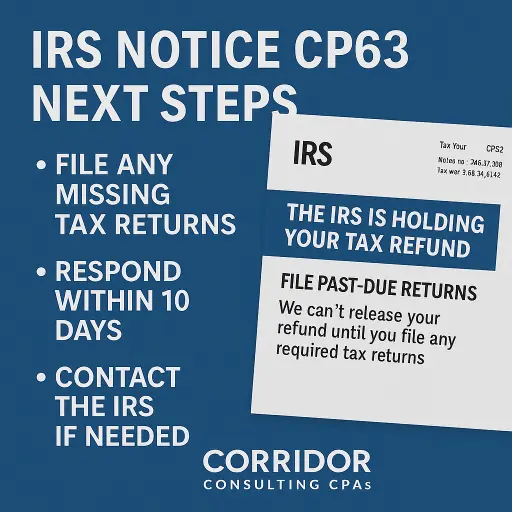
If you just got IRS Notice CP63, you were probably expecting a refund—only to find out the IRS is holding it.
CP63 means the IRS processed a recent tax return that shows a refund is due, but it believes you have unfiled returns from earlier years and may still owe tax. Until you clear that up, your refund is basically frozen.
As a CPA firm based in Cedar Rapids, Iowa, Corridor Consulting regularly helps taxpayers whose refunds are being held because of missing or late-filed returns. This notice is a warning sign that the IRS is looking closely at your account—and that it may start filing returns for you if you don’t act.
IRS Notice CP63 at a Glance
- Notice type: Refund hold / return delinquency
- Issued by: IRS Individual Master File (IMF)
- Triggered by: A recently filed return showing a refund and unfiled earlier-year returns
- What it does: Informs you that the IRS is holding your refund until you file required returns or provide an explanation
- Common next step if ignored: IRS prepares Substitute for Return (SFR) assessments for missing years and applies your refund to those balances
- Recommended action: File the missing returns or respond in writing within the deadline on the notice
IRS Notice CP63, Explained Section by Section
1. Which Refund the IRS Is Holding — and Why
Near the top of CP63, in bold text, the IRS tells you:
- Which tax year’s refund is being held (for example, your 2024 refund), and
- Which prior years it believes you have not filed (such as 2020–2023).
The IRS is essentially saying:
“We know you’re due a refund for this year, but we think you still owe us for earlier years. We’re going to hold your refund until we figure out how much you really owe.”
Instead of sending you money now and chasing you later, the IRS wants to first assess any back balances—including penalties and interest—and then apply your current refund against those amounts.
2. What the IRS Wants You To Do Now
In the next section, CP63 tells you exactly what the IRS wants: file the missing returns.
The notice typically gives three ways to do that:
- File electronically through a paid or volunteer preparer (available only for the most recent three years that are still open for e-file).
- Fax signed returns to the fax number listed on the notice (commonly 855-279-2109).
- Mail signed returns to the address listed on the notice.
If you believe you don’t need to file—for example, because your income was below the filing threshold or you already filed and the IRS lost it—the notice instructs you to send a written explanation with a copy of CP63 to the same address or fax number.
3. What the IRS Says Will Happen Next
After you file the missing returns or send an explanation, the IRS will process everything and then do one of two things:
- Apply your refund to back balances
If your older-year returns show tax due, the IRS will apply your held refund to those balances. You may receive a notice explaining that your refund was used to pay prior-year tax, penalties, and interest. - Release all or part of your refund
If you don’t end up owing as much as the IRS expected—or you’re actually due refunds for those prior years—you may receive a refund check for the remaining amount after everything is netted out.
If your refund isn’t enough to cover all new assessments, you’ll later receive a separate bill for the remaining balance.
4. What Happens If the IRS Doesn’t Hear From You
Near the end of CP63, the IRS explains what it will do if you ignore the notice and fail to respond within the deadline (often about 10 days from the date on the letter):
- It will continue to hold your refund, and
- It may determine your missing-year taxes using third-party information (W-2s, 1099s, and other reports filed under your Social Security number).
When that happens, the IRS can prepare Substitute for Returns (SFRs) on your behalf. SFRs often:
- Ignore deductions and credits you might have claimed, and
- Result in inflated tax balances, penalties, and interest.
Your refund will then be applied to the newly created balances—and you may still end up owing more.
What You Should Do If You Receive IRS Notice CP63
Step 1: Confirm Whether You Actually Need to File
First, make sure the IRS is right about your missing returns.
Ask yourself:
- Did you truly skip filing for the years listed?
- Did you file but never receive confirmation or a notice of processing?
- Did you move, change preparers, or file paper returns that might not have been logged correctly?
Pull your records, tax software confirmations, or prior preparers’ files. If you’re in Cedar Rapids or elsewhere in Iowa, this is where working with a CPA who can pull IRS transcripts and reconcile them with your records becomes invaluable.
Step 2: Dispute the Notice if the IRS Is Wrong
If you confirm that you did file the returns the IRS claims are missing—or that you weren’t required to file for those years—you should dispute the notice.
You can:
- Call the phone number listed on CP63, and/or
- Fax or mail a signed letter explaining the situation, along with:
- A copy of your CP63 Notice
- Copies of the filed returns (if you have them)
- Any proof of filing (certified mail receipts, e-file confirmations, etc.)
Be prepared for multiple calls and delays; IRS account corrections are rarely resolved in one conversation. Many of our clients hire Corridor Consulting CPAs specifically so they don’t have to fight this alone.
Step 3: File Your Missing Returns (If They’re Actually Missing)
If you truly did not file one or more of the years listed on CP63, the most important step is to get those returns filed quickly and accurately.
You generally have about 10 days from the date of the notice to respond before the IRS continues down the SFR path, but practically speaking, you want to move as fast as you reasonably can.
Key points:
- Use accurate income data from IRS wage and income transcripts.
- Don’t guess at deductions—reconstruct records where possible.
- File older years by mail or fax if e-file is no longer available.
Filing correct returns:
- Stops additional failure-to-file penalties from building, and
- Gives you the best chance at reducing the balances that an SFR would have created.
Step 4: Provide an Explanation If You Truly Don’t Need to File
In limited situations, you may not be required to file for a year listed on CP63—for example, if:
- Your income was below the filing threshold,
- All your income was covered by withholding and no filing requirement applied, or
- The year in question was already covered by a return filed under another taxpayer ID (such as a joint return).
In those cases:
- Draft a clear, signed letter explaining why no return is required,
- Identify exactly which tax years you’re talking about, and
- Include a copy of your CP63 Notice before mailing or faxing it to the address/number in the letter.
Keep copies of everything you send.
Why CP63 Is a Sign to Bring in a CPA Firm — Not a “Quick Fix” Tax Relief Shop
A CP63 Notice isn’t just about a delayed refund; it’s a warning flag that your account has missing returns, potential SFR exposure, and growing penalties. That’s not something a basic tax prep service or a call-center “tax relief” company is built to handle well. You need a CPA Firm.
What a Licensed CPA Firm Brings to the Table
A firm like Corridor Consulting CPAs can:
- Pull your IRS transcripts and reconstruct what the IRS thinks you filed (or didn’t file).
- Prepare accurate back tax returns that claim every deduction you’re entitled to.
- Analyze whether penalties can be reduced through penalty abatement or reasonable cause arguments.
- Build a long-term tax resolution plan—installment agreement, currently not collectible status, or even offer in compromise if appropriate.
You’re not just checking boxes; you’re repairing your compliance history and protecting yourself from future enforcement.
Why “Tax Relief” Companies May Not Be the Answer
Many national tax relief companies:
- Focus on selling “pennies on the dollar” dreams,
- Outsource return preparation to the lowest bidder, and
- Have limited involvement in actually reconstructing your books or coordinating with a local CPA.
For CP63 cases, the heavy lifting is usually:
- Getting delinquent returns filed correctly, and
- Integrating those filings with your overall tax planning going forward.
That’s core CPA work—not a one-time sales pitch.
How Corridor Consulting CPAs Helps With IRS Notice CP63
At Corridor Consulting CPAs in Cedar Rapids, we help Iowa taxpayers (and clients nationwide) move from “IRS is holding my refund” to “my returns are filed, my plan is in place, and I know what comes next.”
Our typical CP63 support includes:
- Reviewing your CP63 Notice and pulling IRS transcripts
- Identifying exactly which years need to be filed or corrected
- Preparing and filing accurate back returns
- Requesting penalty relief where appropriate
- Designing a forward-looking plan to keep you compliant and avoid future refund holds
We don’t just help you respond to the notice—we help you stabilize your entire tax situation.
Take the First Step
If the IRS is holding your refund because of a CP63 Notice, you don’t have to figure this out alone.
Start by scheduling a short discovery conversation with Corridor Consulting CPAs. We’ll:
- Review your notice,
- Explain what the IRS sees on your account, and
- Outline a practical path to get your returns filed, your refund released (when possible), and your tax situation under control.
Additional IRS Resources on Refund Holds and Unfiled Returns
If you received IRS Notice CP63 and want to dig deeper into your rights and options, these official IRS resources can help:
- IRS: “Understanding Your IRS Notice or Letter” – General guide on how to read and respond to IRS notices and letters, including where to find notice-specific help.
- IRS: “View Your Account Information” – Secure online access to your current balance, payments, and key account details that can help you confirm what the IRS is seeing before you respond.
- IRS: “Get Transcript” – Order tax return and account transcripts so you can verify which years have been filed and what the IRS has on record before you respond to a CP63 refund hold.
- IRS Publication 1, Your Rights as a Taxpayer – Explains the Taxpayer Bill of Rights, including your right to be informed, to challenge the IRS’s position, and to appeal an IRS decision.
- Taxpayer Advocate Service (TAS): Get Help – An independent organization within the IRS that may assist if your CP63 refund hold is causing financial hardship or isn’t being resolved through normal channels.
