There’s No Such Thing as “LLC Taxation” — Here’s What Actually Matters
If you spend any time on social media, you’ve probably seen this line:
“You need to change your LLC taxation so you can save on taxes.”
It sounds authoritative. It’s also wrong.
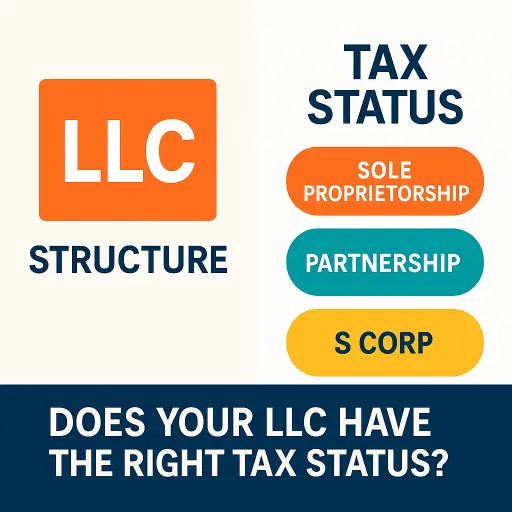
There is no such thing as “LLC taxation” in the way those posts suggest. An LLC is a legal structure created under state law, not a federal tax category. For tax purposes, the IRS doesn’t care about the letters “LLC” on your operating agreement nearly as much as it cares how that LLC is classified and how you actually elect to be taxed.
If you’re a business owner, this distinction isn’t just technical trivia. Picking the wrong tax status for your LLC can:
- Increase your overall tax bill
- Add unnecessary complexity and compliance costs
- Create ugly surprises when you sell your business or bring in partners
Let’s break down what’s really going on under the hood.
LLC = Legal Shell. Tax Status = Separate Decision.
When you form an LLC with your state, you’re choosing a legal structure that can provide:
- Limited liability protection (if you respect the formalities)
- Flexible ownership and profit-sharing arrangements
- Fewer corporate formalities than a traditional C corporation
But when that LLC’s information hits the IRS, the system does not say:
“Ah, an LLC. We know exactly how to tax that.”
Instead, the IRS asks a different question:
“Based on the number of owners and any elections filed, how should this entity be taxed?”
That’s where tax classification comes in.
The Four Main Ways an LLC Can Be Taxed
Depending on how many owners you have and what elections you file, an LLC can be taxed in at least four different ways:
1. Disregarded Entity (Sole Proprietorship)
Who this applies to:
Single-member LLCs (one owner) that have not elected S corporation or C corporation treatment.
How the IRS sees it:
For tax purposes, the entity is “disregarded.” The activity goes straight on your personal return:
- Schedule C for business income
- Schedule E for rentals
- Schedule F for farms
Key implications:
- All net self-employment income is generally subject to self-employment tax.
- Simple to file; no separate entity return at the federal level.
- Easy to start, but may become expensive from a tax perspective as profits grow.
2. Partnership LLC Taxation
Who this applies to:
Multi-member LLCs (two or more owners) that haven’t elected S corporation or C corporation status.
How the IRS sees it:
The LLC is treated as a partnership and files:
- Form 1065 (U.S. Return of Partnership Income)
- Schedule K-1s for each partner, reporting their share of income, deductions, and credits
Key implications:
- Very flexible for sharing profits, losses, and special allocations.
- Certain items can trigger self-employment tax for active owners.
- Basis, capital accounts, and distributions must be tracked carefully to avoid unpleasant surprises.
3. S Corporation LLC Taxation
Who this applies to:
LLCs (single- or multi-member) that file Form 2553 to be treated as an S corporation.
How the IRS sees it:
The entity becomes an S corporation for tax purposes and files:
- Form 1120-S
- K-1s to owners (shareholders)
Key implications:
- Owners who work in the business must be paid “reasonable compensation” as W-2 wages.
- Profit above wages can potentially avoid self-employment tax, which is why social media loves this strategy.
- Additional payroll, bookkeeping, and compliance requirements.
- Not a fit for every ownership structure (there are eligibility rules and shareholder limits).
Done right, S corp status can be powerful. Done wrong, it can create exposure for back payroll taxes and penalties.
4. C Corporation LLC Taxation
Who this applies to:
LLCs that file Form 8832 to be treated as a C corporation.
How the IRS sees it:
The entity is now a C corporation for tax purposes and files:
- Form 1120
Key implications:
- The corporation pays its own tax at the corporate rate.
- Dividends to owners are taxed again on the personal return (the classic “double tax”).
- In some cases—especially where profits are reinvested or a future sale is planned—C corp status can make sense. In others, it’s a costly mismatch.
Why “LLC Taxation” Language Is a Red Flag
When someone confidently talks about “LLC taxation” as if it’s one thing, that usually tells you three things:
- They’re blurring legal structure and tax classification.
- They’re probably recommending one-size-fits-all answers (usually “make your LLC an S corp at $X income”).
- They’re not asking the two questions that actually matter:
- How does this business really operate?
- What are the owner’s short-term and long-term goals?
It’s not that every tip online is wrong. It’s that the nuance gets lost—and your situation is more complicated than a 30-second clip.
How Choosing the Wrong Tax Status Can Cost You
Here are a few ways a mismatched classification can hurt:
- Overpaying self-employment tax
A profitable single-member LLC that stays a disregarded entity for too long may be leaving money on the table. - Jumping into an S corp too early
If profits are low or inconsistent, the cost and complexity of payroll and separate filings can outweigh the tax savings. - Ignoring state-level issues
Some states treat S corps differently, impose additional fees, or don’t recognize certain classifications the way you might expect. - Complicating a future sale
The ideal structure for years of steady operations might not match what’s optimal when you sell or bring in investors. - Messy owner compensation
“Reasonable compensation,” guaranteed payments, distributions, and benefits all interact differently depending on your chosen tax status.
These aren’t theoretical. They show up in real numbers: higher tax bills, missed deductions, or expensive cleanup work later.
Why Your Choice of Firm Matters: CPA Firm vs “Tax & Accounting” LLCs
Once you understand that there’s no such thing as “LLC taxation,” the next question is obvious:
Who is actually giving you advice about how your LLC should be taxed—and are they qualified to do it?
In Iowa, there’s a growing problem: many businesses using “Tax & Accounting” in their name are not licensed CPA firms and may not employ any licensed CPAs at all.
The Rise of Unlicensed “Tax & Accounting” Firms
As many CPA owners retire, their practices are being bought by:
- Entrepreneurs with no accounting background
- Financial advisors and private equity groups
- Non-CPA “consultants” who want to sell tax and advisory services
Because Iowa requires a CPA firm to be majority-owned (51%+) by CPAs to legally operate as a CPA firm, many buyers sidestep this by:
- Forming new LLCs with names like “Trusted Tax & Accounting” or “Accounting & Tax Services”
- Dropping the CPA firm license
- Using “accounting” in the name to mimic the credibility of a licensed CPA firm
The result? Business owners think they’re working with a professional accounting firm—when in reality, they’re working with an unregulated “Tax & Accounting” shop.
What Iowa Law Actually Says
Under Iowa Code § 542.13(9), a person or firm without a CPA certificate, permit, or license cannot use titles that include “accountant,” “auditor,” or “accounting” together with language that implies licensure or special competence.
So if a firm:
- Is not licensed as a CPA firm, and
- Uses “accounting” plus licensure-implying language (like “certified,” “licensed,” or “CPA firm”) in its name,
…it may be violating Iowa law—or at the very least, misleading the public.
Why This Matters for LLC Tax Status and Entity Planning
These “Tax & Accounting” LLCs often advertise:
- Entity structuring advice (LLC vs S corporation, etc.)
- Payroll compliance and “reasonable compensation” planning
- Strategic tax minimization and business advisory
But in many cases, they:
- Don’t have formal tax law training
- Don’t understand how book basis and tax basis interact
- Don’t reconcile your financial statements to your tax return (Schedules L and M-1)
- Don’t catch issues with S corp elections, basis, or compensation
At Corridor Consulting, we routinely see the fallout:
- S corporation elections made without proper payroll setup
- LLCs formed but no timely S corporation election filed
- Owners paying themselves in ways that violate reasonable compensation rules
- Multi-entity structures that look good on paper but create real tax and audit risk
- Missed planning opportunities that could have reduced tax or protected shareholders
These aren’t small mistakes. They’re expensive, sometimes irreversible, and they often start with someone treating “LLC taxation” like a one-size-fits-all answer instead of a technical classification decision.
CPA Firm vs “Tax & Accounting” LLC: What’s the Difference?
A licensed CPA firm in Iowa is:
- Regulated by the Iowa Accountancy Examining Board
- Required to maintain majority CPA ownership
- Obligated to meet continuing education and ethical standards
- Trained in both financial accounting and tax law
- Authorized to represent you before the IRS at all levels
Many “Tax & Accounting” LLCs are:
- Owned by non-CPAs focused on monetizing a client list
- Staffed by a mix of bookkeepers and sometimes an EA
- Not subject to CPA licensing standards or board discipline
- Not trained to design and oversee complex entity structures or long-term tax strategy
They might be able to “get the return filed” and reconcile your bank accounts. But when you’re choosing how your LLC is taxed—and how that choice affects your long-term wealth—you need someone who speaks both languages: tax and accounting.
How Corridor Consulting Approaches This
As a licensed Iowa CPA firm, Corridor Consulting:
- Reviews your entity structure and tax classification as an integrated strategy, not a checkbox
- Understands how your books, payroll, distributions, and returns should work together
- Helps you choose and maintain the right tax status for your LLC based on profit, growth, and exit plans
- Stays accountable to state regulatory standards and professional ethics—not just marketing promises
In short: when you’re deciding how your LLC should be taxed, the label on your entity is just the beginning. The quality and qualifications of the firm behind that advice can be the difference between a clean, efficient structure and years of avoidable tax problems.
How to Think About the “Right” Tax Treatment for Your LLC
Instead of asking, “What’s the best LLC taxation?” a better set of questions is:
- How much profit do we realistically expect over the next 1–3 years?
- How much do the owners need to take out of the business versus reinvest?
- Are we planning to bring in partners, sell, or seek outside capital?
- What does our state do with each type of entity?
- How much complexity are we willing to manage in exchange for potential savings?
A solid advisor will walk through these points with you and then recommend:
- Staying as a disregarded entity or partnership for now
- Electing S corporation status with a documented reasonable salary
- In more specialized cases, considering C corporation treatment
There is no universal “best” answer—only a best fit for your facts and goals.
Why This Matters More for Entrepreneurs and Real Estate Owners
If you’re a W-2 employee with a tiny side hustle, the stakes are relatively low.
If you’re:
- A full-time business owner
- Running multiple LLCs or entities
- Investing in real estate with partners
- Managing significant revenue or profit
…then this choice is part of your long-term wealth strategy, not just a form you file once.
The wrong setup can:
- Increase audit risk
- Make it harder to qualify for financing
- Complicate distributions among owners
- Limit your flexibility when opportunities come up
The right setup quietly supports everything you’re trying to build.
A Better Approach Than Social Media LLC Taxation Sound Bites
Here’s a practical path forward if you’re feeling overwhelmed:
- Inventory your current structure.
List each LLC, who owns it, what it does, and how it’s currently being taxed. - Pull your recent returns.
Look at which forms were filed: Schedule C, Form 1065, Form 1120-S, Form 1120. - Clarify your goals.
Are you trying to minimize self-employment tax, prepare for a sale, or simply keep compliance as simple as possible? - Have a professional walk through the options.
A CPA who understands both tax law and business operations can show you scenarios: “If we stay as-is vs. elect S corp vs. restructure altogether.” - Review your setup every few years.
Revenue, profit margin, and life goals change. Your entity and tax classification should occasionally be revisited too.
The Bottom Line on LLC Taxation
- LLC is a legal wrapper, not a tax result.
- The IRS looks at how your LLC is classified—disregarded entity, partnership, S corp, or C corp.
- Social media shortcuts about “LLC taxation” ignore the nuance that actually affects your tax bill.
- The right choice depends on your profits, state rules, risk tolerance, and long-term plans—not a single income threshold or trendy strategy.
If you’re not sure whether your current structure fits your situation, that uncertainty is a signal—it’s time to have someone who lives in this world every day take a look.
If you’d like a professional review of how your LLC is taxed and whether a different classification or structure would better support your business and long-term wealth, we can walk you through it step by step and show you the numbers before you make any changes.
Take the First Step
If this raised questions about how your LLC is taxed—or whether your current “Tax & Accounting” firm is really acting in your best interest—you don’t have to sort it out alone.
Here’s a simple way to move forward:
- Complete our Discovery Chat Questionnaire.
Share how your business is structured today, who owns what, and what you’re trying to build over the next few years. - Meet with us for a focused Discovery Chat.
We’ll walk through your current entity setup, how your LLC is actually being taxed, and where we see potential risk or missed opportunities. - Decide on your next step with clarity.
Whether that’s keeping your current classification, electing a new tax status, cleaning up past filings, or transitioning away from an unqualified “Tax & Accounting” provider, you’ll leave with a clear path—not generic social-media advice.
You don’t need to become a tax expert. You just need a qualified CPA firm that understands how structure, bookkeeping, and tax law all fit together—and is willing to explain your options in plain English.
Resource Guide: Learn More About Entity Choice and Professional Standards
If you’d like to dig deeper into the concepts behind this article, these resources are a good starting point:
- IRS – Limited Liability Company (LLC)
- IRS – S Corporations
- IRS – Form 8832, Entity Classification Election
- IRS – Form 2553, Election by a Small Business Corporation
- Iowa Accountancy Examining Board – License Lookup
(To verify whether a firm is actually a licensed CPA firm.) - Iowa Secretary of State – Business Entities Search
(To see who owns the entity you’re working with and how it’s organized.)
You can use these to verify your current advisor, confirm how your LLC is classified, and prepare better questions for your next conversation with a CPA.
