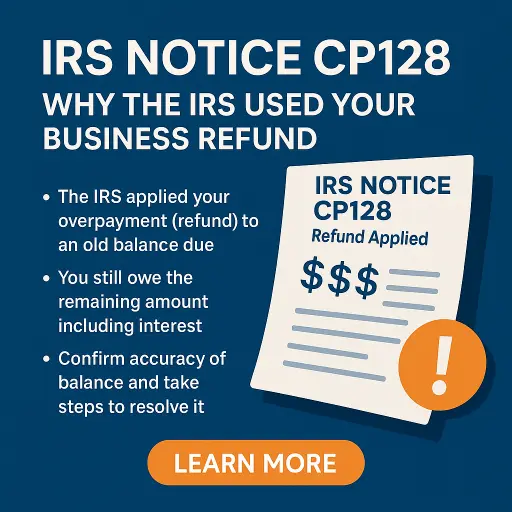
You filed a business return expecting a refund—and instead got IRS Notice CP128 saying the IRS grabbed that overpayment and used it to pay an older balance.
CP128 is the IRS’s way of telling you:
- Your business had a refund or overpayment on one return, and
- That money was diverted to a prior-period tax debt, and
- You still owe the remaining balance.
For businesses that run tight on cash, this can be a nasty surprise. The notice is a warning that your account isn’t clean, interest is continuing to accrue, and the IRS is still in collection mode until everything is fully resolved.
In this guide, we’ll walk through what IRS Notice CP128 means, how to read it, and what to do next to protect your business.
IRS Notice CP128 at a Glance
- Notice type: Refund applied to balance due (business)
- Generated by: IRS Business Master File (BMF) systems
- What usually comes before it: Filing a business tax return that shows a refund or overpayment
- What it tells you: The IRS applied that overpayment to an older balance, and there’s still a remaining amount due
- Recommended action: Confirm the numbers, correct any errors, then pay in full or enter a resolution for the remaining balance
IRS Notice CP128, Section by Section
1. Notice and Billing Summary
The first section of CP128 explains the core issue:
- Your business return showed an overpayment (or refund).
- Instead of sending that money back, the IRS offset it to a prior-period balance.
- After that offset, there is still a balance due.
You’ll typically see:
- The form and tax period where the overpayment came from (for example, Form 1120, Form 1065, or Form 941).
- A billing summary showing:
- Prior balance
- Amount of overpayment applied
- Additional interest and penalties
- New total due
The key takeaway: the refund is gone—and the IRS still expects more from you.
2. What the IRS Wants You To Do Immediately
Next, the notice shifts to urgency.
The IRS will:
- Ask you to pay the remaining balance as soon as possible
- Explain that paying promptly helps you avoid more interest and penalties
- List payment options, such as:
- Electronic payment through IRS online tools
- Mailed check or money order with the payment coupon
If you can’t pay everything at once, the notice may:
- Encourage you to pay as much as you can now, and
- Suggest contacting the IRS to discuss a payment plan or other arrangement
If you think something is off—wrong amount, wrong period, missing payments—the notice will include a phone number you can call to dispute or clarify.
3. Payment Coupon
If your business decides to pay by mail, CP128 includes a payment coupon at the bottom.
When you use it:
- Make your check or money order payable to “United States Treasury.”
- Print your EIN, tax period, and form number on the payment.
- Include the coupon in the envelope so the IRS can quickly match the payment to the right account.
Even if you plan to pay electronically, keep the coupon with your records as proof of the notice and its date.
4. Payments Credited to the Tax Period
Further down, CP128 shows a table of payments and credits that have already been applied to the tax period with the balance due.
You’ll see:
- Dates the IRS recorded deposits, credits, or overpayments
- Amounts applied on each date
- How those credits brought the balance down (but not to zero)
This section is where you can spot issues such as:
- Payments you made that don’t appear
- Amounts that look lower than what you sent
- Credits that seem to have been applied to the wrong period
If anything looks wrong, that’s a reason to call the IRS or have your CPA contact them and compare against your own records.
5. Interest Charges
CP128 includes a breakdown of interest charged on your business’s unpaid balance.
You’ll typically see:
- A total interest amount
- An explanation that the IRS is legally required to charge interest on unpaid tax
- A table showing:
- Interest periods
- Interest rates in effect for each period
- How interest accumulated over time
For C corporations, special rules apply when there is a large underpayment (generally $100,000 or more). In that case, the interest rate on a “large corporate underpayment” is higher than the standard underpayment rate—effectively an extra 2 percentage points above the normal corporate underpayment rate.
That higher rate continues to apply until the underpayment is fully resolved.
6. Additional Information and Where to Get Help
Finally, CP128 wraps up with additional information, including:
- A link to the IRS page “Understanding Your CP128 Notice”
- General contact information for IRS forms, instructions, and publications
- A mailing address if you need to send written correspondence
If you write to the IRS, always include:
- Your EIN
- The tax period and form number
- A copy of the notice
- A clear explanation of what you’re disputing or asking
What To Do If You Receive IRS Notice CP128
Step 1: Confirm the IRS Balance Is Actually Correct
Start by checking whether the IRS is right about:
- The prior balance they say you owed
- How your overpayment was applied
- The remaining amount due
Compare your records to:
- The CP128 billing summary
- Your business’s IRS transcripts
- Your prior-year returns and payment history
Ask:
- Did we really owe this prior balance?
- Were all payments, deposits, and credits applied correctly?
- Does the remaining amount match our own calculations?
If something doesn’t line up, you may be dealing with a processing error, a misapplied payment, or a missing credit.
Step 1a: Dispute the CP128 Notice if Something Is Wrong
If you believe the IRS has made a mistake:
- Call the number on the notice, and
- Be prepared with:
- Copies of cancelled checks or bank confirmations
- Payroll and deposit records
- Any prior IRS notices and correspondence
You can also follow up in writing:
- Clearly explain the issue (for example, “payment on X date not applied”).
- Include your EIN, form number, tax period, and a copy of CP128.
- Send it by a method that gives you proof of delivery.
In practice, this often takes more than one call or letter. Having a CPA or tax professional handle these conversations can save your internal team time and frustration.
Step 2: If You Can Pay the Remaining Balance in Full, Consider Doing It
If the balance is correct and your business has the cash, the cleanest solution is to pay the remaining amount in full.
Why that matters:
- It stops additional interest and penalties from piling up.
- It clears the prior period so future refunds aren’t automatically grabbed.
- It gets your business out of the IRS collection pipeline and back to neutral.
You can pay:
- Online via IRS business payment options or online payment agreements
- By check or money order with the payment coupon
- Through your IRS online account
Step 3: If Full Payment Isn’t Realistic, Explore Business Tax Relief Options
If paying in full would strain your business’s cash flow, you still have options.
Business Installment Agreement
You may be able to set up a payment plan for your business:
- Short-term or long-term payment plans are available, depending on balance and filing status.
- Certain “in-business” agreements (like In-Business Trust Fund Express for employers) can streamline the process if you qualify.
This won’t stop interest, but it will give you a structured, predictable monthly payment and generally prevents the IRS from jumping straight to levies.
Currently Not Collectible (Hardship) Status
If your business is genuinely struggling and cannot make meaningful payments after covering necessary expenses, you may qualify for currently not collectible (CNC) status.
- Collection efforts can be paused.
- Interest continues to accrue.
- The IRS may revisit your situation periodically.
Offer in Compromise (OIC)
In rare cases, a business may qualify to settle for less than the full amount owed through an Offer in Compromise.
- Approval depends on your business’s ability to pay, assets, and future income potential.
- It’s not a quick or guaranteed option, but for the right fact pattern, it can resolve an otherwise unmanageable liability.
Why Many Tax Relief Firms Don’t Go Far Enough for CP128 Business Cases
When a business owner sees CP128 and realizes a refund disappeared, the instinct is often to Google “tax relief” and call the first national firm with a big promise.
But for business cases—especially those involving payroll taxes, multiple entities, or larger balances—that can be risky. You need a CPA Firm.
Patterns we often see:
- They accept the IRS’s numbers without challenge.
Many firms focus on payment plans and settlements without asking whether the underlying returns, deposits, and credits are correct. - Little or no review of prior filings and payroll.
For example, with Form 941 or 940 issues, no one checks whether deposits were properly mapped, whether third-party processors misapplied payments, or whether prior period adjustments were handled correctly. - Limited understanding of business cash flow and strategy.
A solution that looks good on paper (like a high monthly payment plan) can quietly choke your operations.
At Corridor Consulting, we take a different approach:
We start by asking, “Are the IRS records and your returns accurate?”
Only after we’re confident the numbers are right do we design a resolution strategy that fits how your business actually operates.
How Corridor Consulting Helps When You Receive IRS Notice CP128
For us, CP128 is a signal that your business needs:
- Clarity on what really happened, and
- A sustainable plan for dealing with the remaining balance and avoiding repeat problems.
Our typical process includes:
- Transcript and notice review
We pull and review your IRS business transcripts, prior notices, and relevant returns to see exactly how the overpayment was applied and what remains. - Return and payment reconciliation
We match IRS records against your books, bank statements, and payroll records to identify missing or misapplied payments, incorrect coding, or reporting errors. - Correction where needed
If we discover inaccuracies, we’ll often recommend amended returns or other corrections so you’re negotiating based on accurate numbers—not a flawed starting point. - Resolution strategy built around your business
Once the numbers are right, we help you evaluate:- Installment agreements or in-business payment plans
- Hardship or temporary relief options
- Whether an Offer in Compromise is worth exploring
- Penalty relief opportunities where facts support it
Our goal isn’t just to “make the notice go away”—it’s to stabilize your tax account and support your long-term business plans.
Key Takeaways About IRS Notice CP128
- IRS Notice CP128 means the IRS used your business refund to pay an old balance—and you still owe what’s left.
- The notice explains which return the overpayment came from, which period it was applied to, and how much is still unpaid, including interest.
- Your first job is to confirm that:
- The prior balance is real
- All payments and credits are properly applied
- The remaining amount is accurate
- If the numbers are correct, consider paying in full or using a business payment plan, hardship status, or (in limited cases) an Offer in Compromise.
- Many tax relief firms focus on forms and phone calls, not whether the IRS data and your returns are right. A deeper, CPA-led review often pays for itself.
You don’t have to navigate CP128 alone—and you don’t have to let the IRS quietly consume every future overpayment your business generates.
Take the First Step
If your business received IRS Notice CP128 and you’re not sure why your refund disappeared—or how to handle what’s left:
Complete our Discovery Chat Questionnaire to begin your complimentary consultation.
We’ll review your IRS business transcripts, explain why the overpayment was applied, verify the accuracy of your balance, and outline a practical plan to resolve it and move forward.
Additional IRS Resources
For more detail directly from the IRS:
