Receiving IRS Notice CP05 can be confusing and frustrating — especially if you were expecting your tax refund and now it’s being delayed without any clear explanation. Unlike audit letters or balance-due notices, CP05 does not accuse you of doing anything wrong. Instead, it means the IRS needs more time to verify specific items on your tax return before releasing your refund.
This article explains what IRS Notice CP05 is, why you received it, how long the review may take, and the steps you should take next.
What Is IRS Notice CP05?
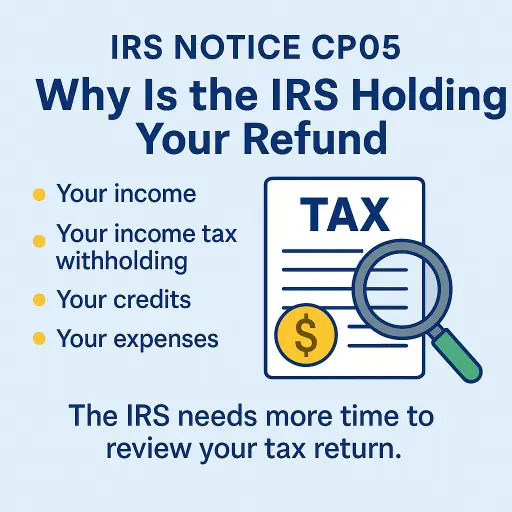
IRS Notice CP05 tells you that the IRS is holding your refund while it reviews your recently filed tax return. This review is part of the IRS’s return integrity and identity verification efforts.
The notice usually means the IRS wants to verify the accuracy of one or more of the following:
- Your income
- Your income tax withholding
- Your credits (EITC, ACTC, AOTC, Child Tax Credit, etc.)
- Your expenses (such as Schedule C deductions or business losses)
The CP05 notice does not require you to send the IRS any documents at this time. Instead, it’s a heads-up that the IRS is still reviewing your return.
IRS Notice CP05 At a Glance
| Category | Details |
|---|---|
| Notice Type | Return Processing / Refund Hold |
| Generated By | IRS Accounts Management |
| Preceded By | Filing of tax return |
| What It Means | IRS needs more time to verify information |
| Refund Status | Refund is paused until review is complete |
| Recommended Action | Wait for follow-up communication |
Why the IRS Is Holding Your Refund
Several issues can trigger a refund freeze and issuance of Notice CP05:
1. Income mismatch
If the income on your tax return does not match what the IRS received from employers or payers (W-2s, 1099s, K-1s, etc.), the IRS may pause your refund to review it.
2. Refundable credits
Returns claiming certain refundable credits receive extra scrutiny due to high rates of identity theft and fraud:
- Earned Income Tax Credit (EITC)
- Additional Child Tax Credit (ACTC)
- American Opportunity Tax Credit (AOTC)
3. Large business losses or unusual deductions
Self-employed taxpayers with large Schedule C losses or atypical deductions may trigger a review.
4. Identity theft concerns
If your return triggers IRS identity protection filters, CP05 may be issued while the IRS ensures the return was filed by you.
Important:
The CP05 notice will NOT tell you exactly what the IRS is questioning.
This is normal — the IRS does not disclose which item triggered the review.
IRS Notice CP05 Explained: Section by Section
Part 1: What the IRS Needs You to Know
In this section, the IRS explains:
- Your return is being reviewed for accuracy
- There’s nothing you need to do right now if you already filed
- They will send one of three outcomes after the review:
- Your refund is approved and released
- A request for more information
- A denial of all or part of your refund, with appeal rights
The IRS states the review may take up to 60 days. If 60 days pass with no further notice, you may contact the IRS or check your refund status online.
Part 2: What the IRS Says You Need to Do
If you already filed your tax return, you generally don’t need to take any action at this point.
However, if you did NOT file a tax return, receiving CP05 is a red flag. It may mean:
- Someone else used your personal information to file a fraudulent return
- The IRS is holding the fraudulent refund until it verifies the filing
In this scenario, you should complete Form 14039 – Identity Theft Affidavit and send it to the address listed on your notice.
Part 3: Where to Find More Information
The CP05 notice points you to several key resources:
- The IRS’s CP05 webpage
- Identity theft protection resources
- IRS Identity Protection PIN registration
- Taxpayer rights under IRC § 7803(a)(3)
- Taxpayer Advocate Service (TAS)
- Local Low-Income Taxpayer Clinics (LITCs)
TAS may help if:
- Your refund is delayed longer than 60 days
and - You meet certain hardship or procedural criteria
What You Should Do If You Receive IRS Notice CP05
Here’s the correct sequence of actions:
Step 1: Do Nothing Immediately (If You Filed)
If you filed your tax return and the return is legitimate, the CP05 notice does not require action at this time. The IRS will contact you if they need documents.
Step 2: Monitor for Additional IRS Mail
Within 60 days, the IRS will either:
- Release your refund
- Send a CP05A or CP05B request for documents
- Send a notice proposing adjustments
- Ask questions about income, identity, or credits
Respond promptly if they request additional information.
Step 3: Act Immediately If You Did NOT File a Return
If you did not file the return:
- Complete Form 14039 – Identity Theft Affidavit
- Mail it to the IRS address on the CP05 notice
- Monitor your mail for follow-up identity verification steps
- Protect your credit and financial accounts
Step 4: Contact the IRS If 60 Days Have Passed
If you receive no follow-up notice after 60 days:
- Call the IRS at the number on your CP05 notice
- Check your refund status online
- Ask if your return is under identity theft or income verification review
CP05 vs. CP05A vs. CP05B — What’s the Difference?
- CP05
“We’re reviewing your return. Please wait.” - CP05A
“Send us supporting documentation (income, withholding, credits).” - CP05B
“We need identity verification or more information.”
If you receive CP05A or CP05B, you must respond.
Why You Should Work With a CPA Firm (Not a Tax Relief Company)
Many “tax relief” companies market heavily to taxpayers facing IRS problems — but CP05 cases require return reconstruction, credit analysis, and identity verification, not “negotiation.”
Here’s why a CPA firm is the better choice:
What Tax Relief Firms Commonly Do
- Salespeople handle intake (not licensed professionals)
- One-size-fits-all “relief packages”
- No deep return analysis
- No expertise in EITC/ACTC qualification rules
- No identity theft resolution experience
- High upfront fees with no guarantee of IRS outcome
What a CPA Firm Provides
- Licensed, regulated professionals
- Deep understanding of:
- refundable credits
- income verification
- return integrity filters
- Schedule C/business loss rules
- Ability to rebuild the return correctly
- Expertise resolving identity theft issues
- Guidance on handling follow-up letters (CP05A/CP05B)
- Clear communication with the IRS on your behalf
For CP05 cases, the difference is simple:
You need accuracy, not salesmanship.
A CPA firm is structured to provide that accuracy.
How Our Firm Helps Taxpayers Who Receive Notice CP05
When you work with us, we help you:
- Review your tax return for accuracy
- Identify items that may have triggered the refund hold
- Reconstruct return items (income, credits, deductions, withholding)
- Determine whether identity theft may be involved
- Prepare you for follow-up notices (CP05A or CP05B)
- Communicate with the IRS if deadlines pass
- Help you secure your refund as quickly as possible
You’re not left guessing — you gain clarity and a plan.
Complete our Discovery Chat Questionnaire to begin your complimentary consultation.
We’ll ask a few questions and help determine whether a full Case Evaluation is appropriate.
Key Takeaways About IRS Notice CP05
- IRS Notice CP05 means your refund is being held, not denied.
- The IRS is verifying income, credits, withholding, or identity.
- You generally don’t need to take action unless the IRS requests documents.
- If you did not file the return, it may indicate identity theft — act immediately.
- Reviews typically take up to 60 days, but delays can occur.
- Professional help can reduce stress and ensure you respond correctly.
- You don’t need to face this process alone — and you don’t need to wait until things get worse.
Take the First Step
If you’ve received IRS Notice CP05—or any letter about past due taxes—and you’re not sure what to do next:
Complete our Discovery Chat Questionnaire to begin your complimentary consultation.
During this initial conversation, we’ll discuss your situation, answer your questions, and determine whether a full Case Evaluation is appropriate.
If you choose to move forward with a Case Evaluation, our team will pull and analyze your IRS transcripts, confirm the accuracy of your balance, identify possible errors, and outline the resolution strategies available to you.
This keeps you fully informed before deciding how to proceed—without committing to any services upfront.
Additional IRS Resources to Help with IRS Notice CP05
If you’ve received IRS Notice CP05 and your refund is being held, these official resources can help you understand your notice, protect yourself from identity theft, and get additional support if the delay drags on.
- IRS – Understanding Your CP05 Notice
Official IRS page explaining what CP05 means, why your refund is being held, and when to contact the IRS. - IRS – Notice CP05 (Taxpayer Advocate Service Explainer)
The Taxpayer Advocate Service (TAS) explains CP05 in plain language and outlines your options if the refund delay becomes a hardship. - Check Your Refund Status – Where’s My Refund?
Use the IRS’s online tool to see whether your refund is still processing, approved, or sent. - IRS – Identity Theft Affidavit (Form 14039)
If you did not file the return the IRS is holding, you may be a victim of identity theft. Use Form 14039 to alert the IRS. - IRS – Identity Theft Victim Assistance
Explains what to do if someone filed a fraudulent return using your Social Security number and how the IRS will work your case. - Taxpayer Advocate Service (TAS)
Independent organization inside the IRS that helps taxpayers when they can’t resolve issues through normal channels or are facing financial hardship due to refund delays. - Low Income Taxpayer Clinics (LITCs)
Clinics that may provide free or low-cost representation to qualifying taxpayers in disputes with the IRS, including refund issues and identity theft cases.
