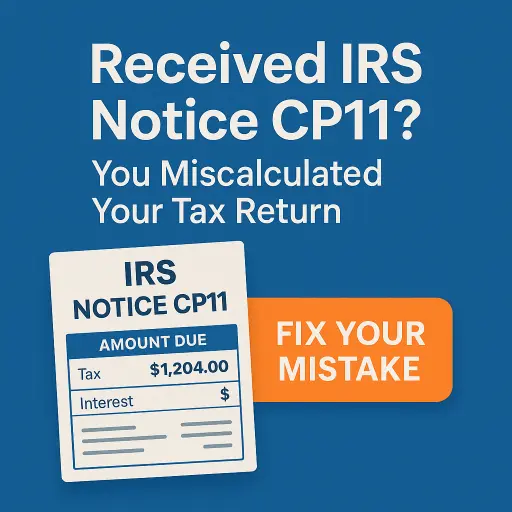
If IRS Notice CP11 just showed up in your mailbox, the IRS is telling you something very specific: it believes there is a math or calculation error on your tax return, and that mistake resulted in a balance due of at least $5.
Sometimes the error is minor. Other times, it eats up a refund you were expecting—or flips your return from a refund to a balance due.
In this guide, we’ll cover:
- What IRS Notice CP11 actually means
- How to read each part of the notice
- What to do if the IRS is right—and what to do if it isn’t
- Options if you agree with the changes but can’t pay in full
IRS Notice CP11 at a Glance
You can think of CP11 this way:
- Notice type: Math error / recalculation notice
- Generated by: IRS tax return processing systems
- Preceded by: Filing of your tax return
- Followed by: Assessment of additional tax if you don’t respond
- Recommended action: Check whether the IRS’s changes are correct, then decide whether to pay, dispute, or seek penalty relief and payment options
In plain language: the IRS re-ran your return, thinks it found a mistake, and has already adjusted the numbers. Now it expects you to either agree (and pay) or contact them if you disagree.
Common issues that trigger CP11 include:
- Incorrect deductions
- Incorrect or inconsistent dependent information
- Income that was reported incorrectly or left off
- Straightforward arithmetic mistakes
If your original return showed a refund, CP11 usually means the IRS is recalculating that refund and may reduce it or turn it into a balance due. You generally won’t receive any refund until the CP11 changes are processed.
IRS Notice CP11, Section by Section
Part 1: Amount Due and Billing Summary
The first section gives you a snapshot of what the IRS thinks you now owe.
You’ll typically see:
- Your new total balance due
- A breakdown between:
- Original tax
- Penalties
- Interest
The notice usually explains that you have about 21 days from the date on the notice to pay this revised balance to avoid additional penalty and interest accrual.
If you look at the explanation, you’ll often see a short description like “We changed your deduction for…” or “We adjusted your taxable income because…”. That’s your starting clue about what changed.
Part 2: Why the IRS Changed Your Information
Next, the notice explains what the IRS changed on your return and why.
Common examples include:
- A self-employment tax deduction that was miscalculated or missing because Schedule SE wasn’t included
- An adjustment to dependents (for example, too many children claimed or the same child appearing on more than one return)
- Changes to credits or adjustments that depended on income thresholds
- Arithmetic or transcription errors when numbers were carried from one line or schedule to another
This section is where you match:
- What you originally filed;
- What the IRS says you did; and
- How the IRS believes it should look now.
Part 3: How the IRS Wants You to Resolve the Issue
Here, the IRS moves from “what changed” to “what you should do next.”
Typically, the notice will say something like:
- If you agree with the changes, pay the amount due.
- If you disagree, contact the IRS within a specific timeframe (often around 30 days from the notice date) using the phone number provided.
If you agree, the IRS encourages you to:
- Pay electronically (especially direct debit from a bank account, which doesn’t carry a card processing fee), or
- Use other listed methods (check, money order, etc.)
If you do nothing and don’t contact the IRS, it generally treats your silence as agreement with the changes and moves forward with assessing the additional tax.
Part 4: Options If You Can’t Pay in Full
If paying the full balance within about 21 days isn’t realistic, the notice outlines payment and relief options, which often include:
- Installment agreements:
Pay over time in monthly payments while staying current with future filing obligations. - Offer in Compromise (OIC):
In limited cases, you may be able to settle for less than the full amount if your financial situation supports it. - Temporary collection delay / hardship status (Currently Not Collectible):
If paying anything right now would create serious hardship, the IRS may temporarily pause active collection efforts.
The key is that CP11 is not just “pay now or else.” There are structured ways to deal with a balance even when cash is tight.
Part 5: If You Don’t Agree With the IRS Notice CP11 Changes
If you believe the IRS is wrong about the math error:
- The notice lists a phone number to call.
- You’ll need your CP11 notice, your original return, and any supporting documents ready.
There is usually a specific window (generally around 30 days from the notice date) to tell the IRS you disagree. If you don’t respond within that timeframe, the IRS typically treats the adjustment as final and moves ahead with assessment and billing.
This process can involve:
- Multiple phone calls
- Explaining your position to more than one representative
- Sending in documents or a corrected return
Many taxpayers have a CPA or tax professional handle this back-and-forth to avoid errors and reduce stress.
Part 6: Tax Calculations
This section shows how the IRS recalculated your tax:
- It often lists your original figures
- The IRS adjusted numbers
- The difference between them
You’ll see changes to:
- Adjusted gross income
- Taxable income
- Total tax
This is where you can pinpoint exactly which line(s) were changed and by how much. If you’re going to dispute the notice, this is the section you’ll rely on to explain where you think the IRS miscalculated.
Part 7: Payments and Credits
Next, CP11 shows how the IRS applied your:
- Withholding (from W-2s and 1099s)
- Estimated tax payments
- Other credits or prepayments
The IRS uses this information to apply payments and credits against your recalculated tax. The result is the remaining balance due shown near the front of the notice.
If you believe your payments or withholding were misapplied or missed altogether, this is the section to scrutinize.
Part 8: Penalties
CP11 also outlines penalties that may apply. Common ones include:
- Failure-to-file penalty:
A monthly penalty (up to a maximum percentage) for filing after the due date, reduced when it overlaps with failure-to-pay. - Failure-to-pay penalty:
A monthly charge, typically a fraction of a percent per month, on unpaid tax. - Estimated tax penalty:
Essentially interest charged when required quarterly estimated payments weren’t made or were underpaid.
The notice will usually show:
- The period each penalty covers
- How the penalty was computed
- A total penalty amount added to your balance
Understanding which penalty you’re being charged can help you and your advisor determine whether penalty abatement is worth pursuing.
Part 9: Interest
After penalties, the IRS adds interest on unpaid tax and certain penalties.
This interest is:
- Calculated using a quarterly rate set by law
- Based on the number of days the balance has been outstanding
- Compounded daily
The CP11 will show how this interest amount is determined and then added to your balance due.
Part 10: IRS Help and Your Rights
CP11 also includes references to:
- Your rights as a taxpayer (often via IRS Publication 1 and Taxpayer Bill of Rights)
- The Taxpayer Advocate Service (TAS), which may help in certain hardship or systemic cases
- Low Income Taxpayer Clinics (LITCs), which can represent qualifying taxpayers in disputes with the IRS
These are important resources, especially if you’re dealing with both a math error and financial hardship.
Part 11: Payment Coupon
Finally, the notice usually includes a payment coupon you can mail with a check or money order.
You’ll be asked to:
- Make your payment to “United States Treasury”
- Include your TIN, tax year, and form number on the payment
- Mail it to the address listed on the notice
The notice typically reiterates that you have about 20–21 days from the date on the notice to pay before extra interest and penalties start adding up.
What To Do If You Receive IRS Notice CP11
Here’s a practical sequence to follow if CP11 lands in your mailbox.
Step 1: Confirm That a Mistake Actually Happened
Start by checking whether the IRS is right about the error.
Ask:
- Does the change they’re describing make sense?
- Did you or your software miss a schedule, mis-key a number, or miscalculate a deduction or credit?
- Do the adjusted figures align with what should have been on the original return?
Compare:
- Your original return
- The IRS’s revised figures on CP11
- Source documents (W-2s, 1099s, K-1s, etc.)
The IRS does make mistakes, especially when dealing with complex returns or partial data. Don’t assume the IRS is always correct—but also don’t assume your original return was perfect.
Step 1a: Dispute the IRS Notice CP11 If You Believe the IRS Is Wrong
If your review suggests the IRS miscalculated:
- Call the number listed on CP11 within the timeframe stated on the notice (often about 30 days).
- Be ready to walk through the numbers and explain why your original calculation is correct, or why the IRS’s approach is flawed.
- You may need to submit documentation or, in some cases, file a corrected or amended return.
It’s rarely a one-and-done phone call. You may speak with more than one representative, and you might have to follow up. Many taxpayers prefer to have their CPA or tax professional handle this process to reduce the risk of miscommunication.
Step 2: If You Agree and Can Pay in Full, Consider Doing So
If you ultimately agree that the IRS’s corrections are accurate—and you can afford to pay:
- Paying the balance within the timeframe on the notice (often about 20–21 days) stops additional penalties and interest from stacking up.
- If you were expecting a refund, some or all of it may be applied against the new balance rather than sent to you.
Paying in full is usually the fastest way to stop the notice chain and move on.
Step 3: Explore Penalty Abatement
If penalties represent a significant portion of your balance, consider whether penalty relief is possible.
This might include:
- First-time penalty abatement for otherwise compliant taxpayers
- Reasonable cause arguments (serious illness, natural disaster, or other circumstances beyond your control)
Even in a math error context, you may still be entitled to some relief if your overall situation fits the criteria.
Step 4: If You Can’t Pay in Full, Consider Tax Relief Options
If you agree that you owe the amount but can’t pay it all at once, you still have options:
- Installment agreement:
Spread payments over time in a manageable monthly amount. - Offer in Compromise (OIC):
In cases of significant financial hardship, you may be able to settle for less than the full amount, based on your income, expenses, and equity. - Currently Not Collectible (CNC) / Temporary hardship:
If paying anything would create serious hardship, the IRS may pause active collection while you stabilize your finances. The debt doesn’t vanish, but you get breathing room.
The right choice depends on your full financial picture, not just the number on the CP11 notice.
Why Many Tax Relief Firms Don’t Go Far Enough for CP11 Cases
When a CP11 shows up, many taxpayers call national “tax relief” firms they see advertised online or on late-night TV. Those firms can sometimes help with basic calls and payment setups—but for many taxpayers, that’s not enough. You might need a CPA Firm.
Some common gaps we see:
- They start from the IRS’s math, not from the underlying return.
Many relief firms don’t re-run your return from scratch. They assume the IRS’s correction is right and jump straight to, “How can we get this paid or settled?” - They rarely review the entire return for additional issues.
A math error on one line can be a clue that other items—credits, basis, depreciation, business expenses—were also off. That broader review often doesn’t happen. - They rarely look at multi-year patterns.
If CP11 reveals a recurring mistake, you may have filed multiple years incorrectly. Most call-center models aren’t designed to dig into that. - They focus on short-term “relief,” not long-term accuracy.
You might get help setting up a payment plan, but no one cleans up the accounting or teaches you how to avoid similar issues going forward.
At Corridor Consulting, our starting point is different:
We ask whether the return itself was prepared correctly, whether the IRS’s math is right, and what needs to change so you don’t keep repeating the same errors year after year.
That often means:
- Reconstructing or rechecking the return, not just the one line the IRS mentions
- Amending returns when it reduces your long-term risk and tax cost
- Looking at how your bookkeeping, entity structure, and planning choices may have contributed to the mistake
For business owners and higher-income taxpayers, this deeper review often makes a bigger difference than any single phone call to the IRS.
How Our Firm Helps With IRS Notice CP11
When a client comes to us with IRS Notice CP11, we typically:
- Analyze the notice and your underlying return
- Compare your filed return to CP11 line by line
- Pull IRS transcripts to see how the IRS processed your return
- Identify exactly what changed and why
- Verify whether the IRS is right
- Re-run calculations, including deductions, credits, and self-employment items
- Identify errors in either your original return or the IRS adjustment
- Determine whether an amendment or a targeted dispute makes sense
- Estimate your true exposure
- Consider not just the additional tax, but also penalties and interest
- Look for opportunities for penalty abatement
- Design a resolution plan
- If you agree with the corrected numbers, map out whether to pay in full, set up a payment plan, or evaluate an OIC or hardship status
- If you disagree, prepare a clear, well-documented position to present to the IRS
- Help you avoid repeat problems
- For business owners, we can move from one-off CP11 support into a broader ongoing relationship—cleaning up bookkeeping, tightening processes, and building proactive tax planning so your return is accurate the first time.
Our goal isn’t just to get you past this notice; it’s to help you build a system where surprise math-error notices are far less likely in the future.
Key Takeaways for IRS Notice CP11
- IRS Notice CP11 means the IRS believes your return has a math or calculation error and has already adjusted your figures.
- The notice shows your recalculated tax, payments, penalties, and interest, and usually gives you about 21 days to pay the new balance.
- Your first step is to verify: is the IRS right about the error, or did it misinterpret your return or data?
- If you agree with the changes but can’t pay in full, options include installment agreements, offers in compromise, and hardship status.
- A deeper, CPA-led review often identifies additional issues or opportunities—both to reduce your long-term tax cost and to prevent repeat errors.
You don’t have to navigate CP11 alone—and you don’t have to make snap decisions based solely on a single IRS letter.
Take the First Step
If you’ve received IRS Notice CP11 and want clarity before you pay, dispute, or ignore it:
Complete our Discovery Chat Questionnaire to begin your complimentary consultation.
During this initial conversation, we’ll discuss your situation, answer your questions, and determine whether a full Case Evaluation is appropriate.
If you choose to move forward with a Case Evaluation, our team will pull and analyze your IRS transcripts, confirm the accuracy of your balance, identify possible errors, and outline the resolution strategies available to you.
This keeps you fully informed before deciding how to proceed—without committing to any services upfront.
Additional IRS Resources
For more details straight from official sources:
